Month: February 2022

  • Disability Insurance, Rolling the Dice

    Disability Insurance, Rolling the Dice

    I just returned from an extended Las Vegas Super Bowl Weekend and was thinking about what to write this week while on the plane back to JFK airport.  In many ways, insurance is gambling! 

    There is a high probability of a disability occurrence happening, such as someone becoming disabled either mentally or physically.  As an Independent Insurance Advisor, also known as a “Field Underwriter,” my job is to ask questions then listen.  This is why we have 2 ears and 1 mouth as we are supposed to listen twice as much as we speak.  Nearly 50% of ALL individuals ages 34 or younger will be disabled for 90 days or longer prior to age 65. 

    As per the Commissioners Individual Disability Tables, CSO/Society of Actuaries, see the chart below:

    Age     Odds of Long-Term Disability     Average disability length

    30                   51%                                                    4.7 years

    35                   48%                                                    5.1 years

    45                   40%                                                    5.8 years

    50                   34%                                                    6.2 year        

    There are generally 2 types of disability income insurance:

    1. Group Disability Income Insurance: Group disability insurance is usually offered by an employer at no cost or for a nominal fee taken out monthly directly from your paycheck.
    2. Individual Disability Income Insurance: Individual disability income insurance (DI) is usually purchased from an agent or broker, similar to life insurance.  There are significant advantages to doing business with an independent insurance broker!

    Advantages of Group Disability Insurance:

    1. Premiums are Affordable
    2. Some policies are portable meaning you can keep it if/when you leave the company
    3. The Business Owner can protect key personnel in the event of disability

    Disadvantages of Group Disability Insurance:

    1. Most policies have a monthly disability income “BENEFIT CAP” which is far less than the employee would need to provide for one’s family
    2. Few policies have an “Own Occupation” definition of disability, meaning it is much harder to trigger a claim versus individual policies.

    Our first task is to assess the risk probability based on the clients’ age, medical history, income level, occupation, amount of coverage, and details of the policy.  We come up with a monthly income need (usually between 40%-65% of income) then shop the policy to different insurance companies.  We then present between 1-3 company options to the client for review.  An Agent can ONLY present 1 company option!  My job is to find a comfortable premium to transfer the majority of the disability risk to the insurance company.

    Regardless of a person’s age, the ability to earn an income is usually their most valuable resource.  Disability income insurance is the one type of insurance that workers cannot do without!  If this is the case, why do less than 50% of adult Americans own a personal disability income insurance policy?  The answer is based on cost, as a typical individual disability income policy will cost between 2%-4% of a person’s salary, depending mostly on age.  This is why it makes sense to apply for an individual disability income policy as young as possible.

    Accidents are what most people think are the main cause of disability. This is incorrect!  Depression and back pain are the most likely to trigger a disability claim.  This has been exacerbated by Covid-19.  Disabilities can be triggered mentally or physically.  As an example, my friend is on disability from post-traumatic stress disorder (PTSD) from Hurricane Sandy. 

    It is critical to consider how your bills would be paid in the event of a disability lasting more than 3 months.  Workers should consider how long they would be able to cover their expenses.  Couples should also consider whether they can survive on one partner’s paycheck if the other were to become ill or injured.  In most cases, an individual private disability income policy is the best way to handle this risk!

    My top 3 tips to consider when buying an individual disability income insurance policy to protect you and your family:

    1. Get Disability Insurance Quotes from an Independent Broker:  An independent insurance broker has a macro view of the marketplace and multiple insurance companies to shop rates and benefits for you.  For example, we have one insurance company that will cover a disability due to a botched elective plastic surgery procedure. 
    2. Buy the “Own Occupation” definition of disability: Not all companies have this definition and some charge extra for it as a rider.  For example, a right-handed surgeon gets his or her right hand mangled when closing the car door.  With an “Own Occupation” policy, said surgeon goes on claim and can collect benefits and still work supervising others.  A policy without “Own Occupation” would have an “any occupation in their field” definition and would NOT be on claim in the previous example.
    3. Do NOT Take a Tax Deduction for insurance premiums paid: This is where your CPA can make a big mistake getting “greedy” for deductions.  If you pay your premiums with “after tax” dollars, 100% of your monthly benefits are TAX FREE!  If you take the small annual premium tax deduction, 100% of your monthly benefits are taxable!

    Are you confused?  These are critical individual and family planning decisions that should not be taken lightly.  For a better understanding of these policies and rates, feel free to reach out to me at Rob@InsuranceDoctor.us.


  • America the Beautiful… and Fat!

    America the Beautiful… and Fat!

    As per the Global Obesity Observatory, America has rated the 14th highest adult obesity rate in the world with 36.47% of all adult Americans being considered obese!  The first 13 countries are ALL islands.  According to the Organization for Economic Cooperation and Development (OECD), The U.S. adult obesity rate will reach 50% by 2030. 

    The Wikipedia definition of obesity is a condition in which excess body fat has accumulated to such an extent that it may have a negative effect on health! 

    The island of Nauru (formerly known as Pleasant Island) leads the world with a 59.85% adult obesity rate.  Japan has the lowest adult obesity rate of first world countries at 4.97%, formerly at 3%.   Perhaps too much fast food has found its way to Japan.  Currently, the lowest adult obesity rate in the world is Vietnam at 1.67%.

    Our addiction to sugar is the primary reason behind the obesity problem.  This starts at a young age eating sugar-laced baby food.  As per the Center for Disease Control (CDC), the U.S. child obesity rate among children ages 2 to 19 increased to 22.4% in 2020, up from 19.3% in 2019.  Unhealthy eating and low levels of physical activity during this pandemic will only make matters worse.

    Unhealthy supermarket shopping habits, fast food, lack of portion control, and lax food labeling laws have contributed to us trending in the wrong direction for many years.  To give you an idea of how bad this is, the average American adult consumes about 19.5 teaspoons of “added sugar” per day.  One teaspoon = 4 grams of sugar.  Take 19.5 X 4 grams = 78 grams of sugar per adult per day. 

    The food industry has 61 names to disguise sugar such as high-fructose corn syrup, caramel, maltose, barley malt, cane juice and dextrin.  Fructose is highly linked to insulin resistance and diabetes.  Creating 61 names for sugar confuses consumers and lowers the odds of recognition!

    See my top 7 tips on how to reduce your sugar intake:

    1. Be aware of boxed foods labeled as “fat free”: Fat free foods are usually loaded with sugar to compensate for a lack of fat, especially in baked goods.  Almost all “boxed” foods will have a high sugar gram content.
    2. Choose fresh fruit over dried fruit: Dehydrated fruits and sauces contain concentrated sugar and are not filling, causing one to eat more.   In many cases dehydrated fruits have three to five times the sugar than natural fruit.
    3. Buy plain over flavored yogurt: Add your own fresh fruit or honey for sweetness, which will have much less sugar.  A 1 cup serving of fruit-flavored yogurt may contain almost 31 grams of sugar.
    4. Avoid feeding infants juice or sweetened foods in their first year: Feed babies more veggies and less fruit to train their taste buds to crave less sweet foods from the beginning.
    5. Cut down weekly dessert intake: If you have dessert every night, start with cutting back to 5 nights per week.  It is easier on the body and mind to wean off the excess added sugar cravings.
    6. Leave sugar out of recipes if possible: Try to either eliminate, reduce, or substitute honey or agave instead of processed sugars.
    7. Drink water instead of sweetened beverages: Nearly two-thirds of children in the USA ages 2-19 consume at least 1 sugar sweetened beverage per day, which includes soda, fruit drinks and energy drinks.  The average 12-ounce cola contains 38.5 grams of sugar, almost as much as the average 12-ounce sweetened iced tea or lemonade as each contain almost 45 grams of sugar.

    What many people do not understand is the ripple effect these poor food habits are having on future generations.  Adult Americans have passed these habits onto our children, which is why juvenile diabetes is at an all-time high.  This causes weight gain, which leads to health problems.  These health issues can lead to popping pills, which is one reason why our health insurance costs and claims have skyrocketed to the highest in the world. 

    According to the Milken Institute, as of September 2020, the total cost of chronic diseases due to American obesity and overweight was $1.72 Trillion, which is equivalent to 9.3% of U.S. gross domestic product!

    Everybody has a unique body and frame.  Our bodies get used to the amount of sugar and calories we feed it on average every day.  By heeding my 7 tips, you should gradually lose weight, which should improve your health and energy! 

  • National Football League $$$$

    National Football League $$$$

    Last weekend I watched what analysts called the best NFL playoff weekend of games all-time!  All 4 games went down to the final play, and both favored number 1 seeds.

    The Green Bay Packers and Tennessee Titans lost at home.  The Buffalo Bills and Kansas City Chiefs put on a show for the ages Sunday night! 

    It makes me think about whether or not the NFL overtime rules should be changed, as Buffalo did not get a chance to respond after the Kansas City Chiefs won the coin toss and scored a touchdown to end the game in overtime.  Under the current playoff overtime rules, the team that has won the coin toss has a record of 10-1.  The only loss was the Saints in 2018!

    The National Football League was formed in 1920 and merged with the American Football League (AFL) in 1966.  Three seasons later, Joe Namath led the heavily underdogged New York Jets to an improbable Super Bowl III win in the 1968-1969 season over the Baltimore Colts.  The Jets have not won another Super Bowl since!

    An old moniker, the (NFL) No Fun League has changed with the times and now allows choreographed team end zone celebrations after touchdowns.  The NFL has come a long way since John Madden (RIP) was coaching the Oakland Raiders in the 1970s.  After leaving coaching, Madden became a great broadcaster using his new “telestrator” toy to teach the viewers at home the way he taught his teams the X’s and O’s of the game.  He continued to keep pace with the times and younger generations with his famous Madden NFL video games.

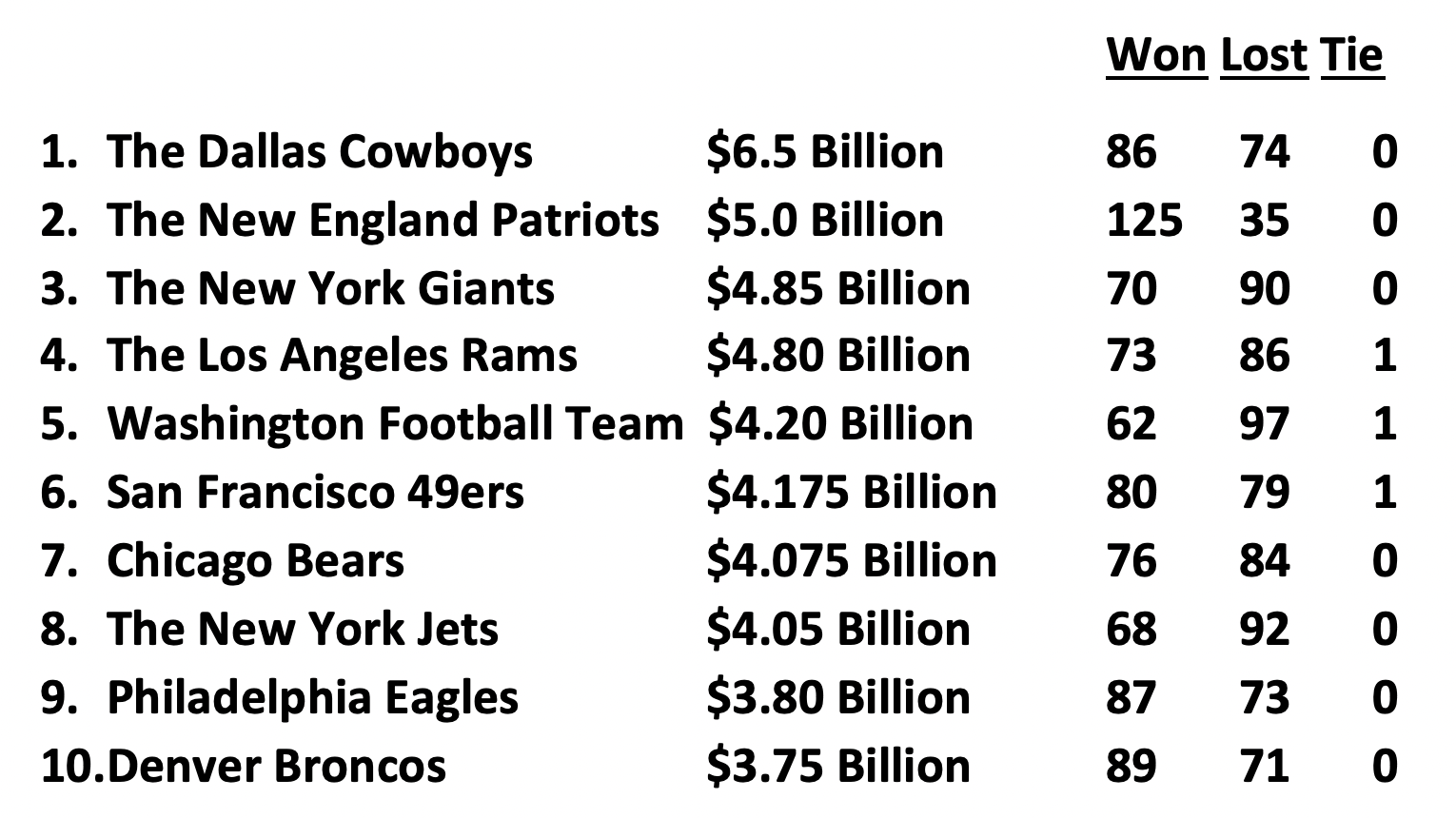
    The 10 Most Valuable Franchises and their 10 Year Records from the decade 2011-2020:                                                                                 

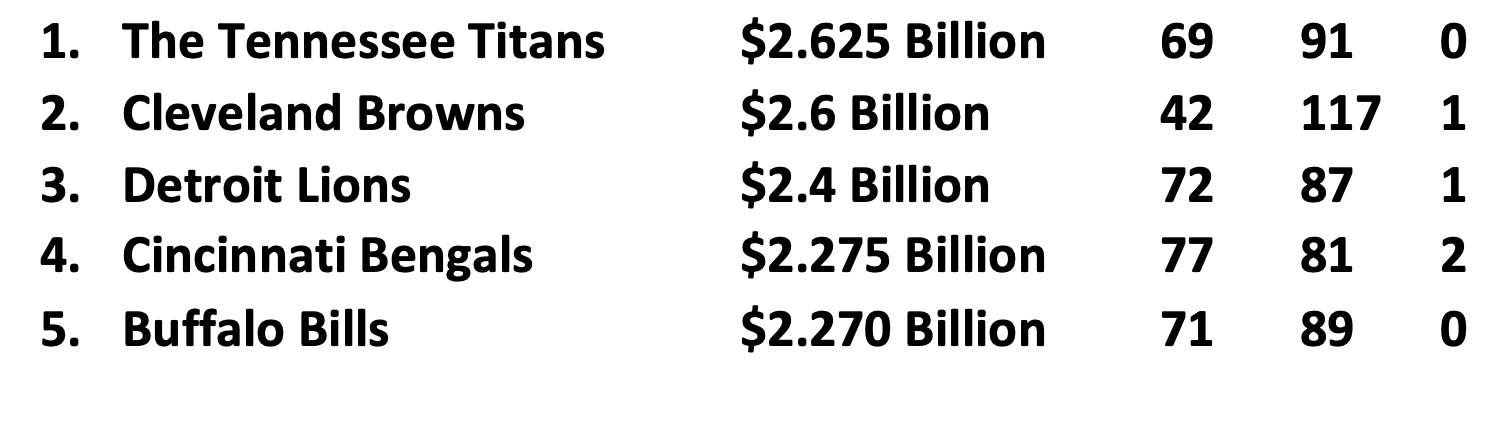
    The Bottom 5 Least Valuable Franchises

    Even with NFL teams taking a financial hit due to Covid-19 restrictions, and playing mostly in empty stadiums in 2020, according to the Forbes financial publication, the average value of NFL teams increased 14% the past year.  A big reason for that is the media partnership deals valued at $112.6 Billion that the NFL signed last March, along with a new Collective Bargaining Agreement.

    For the 15th consecutive season, the Dallas Cowboys topped the Forbes list of the NFL’s most valuable franchises, even though they have not played in a Super Bowl in over 25 years.  According to Forbes, the Cowboys lead the NFL in annual revenues of over $800 Million.  The Cowboys are worth $2 Billion more than the 2 least valuable franchises, the Bengals and Bills, which have a combined value of $4.545 Billion.

    Although every team saw an increase in value in 2020, no team had a bigger increase than the Tampa Bay Buccaneers, after signing Tom Brady and winning Super Bowl LV in 2021.  The Bucs went from the 29th most valuable team at $2.28 Billion to the 21st most valuable at $2.94 Billion. 

    As you can see with our New York Giants and New York Jets, who are 20 and 24 games under .500 respectively for the decade, winning is incongruent to a franchise’s business valuation.

    This fascinated me, so I decided to interview my client and friend Gordon Smeaton.  Gordon spent 20 years as an NFL Executive in charge of fan engagement in global markets.  Gordon is credited with pioneering the NFL pre-season games in Japan, Australia, and Canada.  He set up the first-ever international regular-season game in Mexico City, which then led to the London games now played every season!

    Gordon’s 5 factors that account for the differences in franchise values:

    1. Stadium Size: The number of seats, season ticket holders, personal seat licenses (PSL’s), private suites, club seats and non-shared revenue favor teams that have new facilities and a larger number of premium accommodations.  Larger updated stadiums generate higher per game revenues through ticket sales, parking, food, beverages and merchandise sales.
    2. Stadium Ownership: Not all franchises own their stadia!  Leased facilities tend to drive valuations lower, as revenue may be shared with counties or municipalities, etc.  The most valuable franchises with new facilities tend to attract other events such as concerts, NCAA games, etc.
    3. Market Size: The most valuable franchises are concentrated in larger urban areas, attracting a wider range of partners along with higher prices for sponsorships and advertising deals.
    4. Media: The teams control non-game media so larger markets generate higher revenues for club-controlled content.
    5. Branding: The higher valuation teams are often “National” teams with their fan base spread throughout the country.  This impacts prime-time TV placement and fees that teams can charge their partners.

    It is interesting that the Bills and the Bengals (the 2 lowest valued franchises) were so close to playing this weekend in the conference finals.  Stay tuned for another weekend of exciting NFL playoff games!