Month: September 2023

  • Use Points to Travel This Fall!

    Use Points to Travel This Fall!

    With cooler temperatures, smaller crowds, and more laid-back vibes, the fall provides a welcome respite from the hectic summer pace.

    And since the weather can be more variable and fewer people are venturing far from home, it also tends to be a great time to score deals on flights and lodging.  As you’re sorting out how to maximize your PTO (Paid Time Off) for the rest of the year, consider saving big $$$ by using points. 

    Some issues with using points, whether it is airline, credit card, or hotel points, is that it is confusing and also like trying to hit a moving target as companies are constantly changing their points programs.   Usually, these changes result in points being less valuable. 

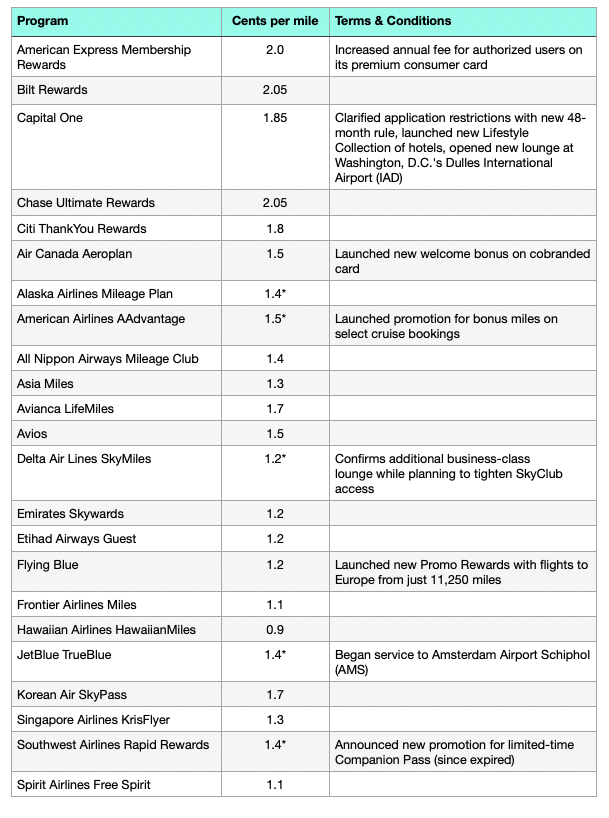
    This is where “The Points Guy” comes in!  They have created formulae to convert points into dollars and cents and vice versa.  If you have an iPhone, feel free to go to the app store and download “The Points Guy” app.  Currently, there is no “Points Guy” app for Androids, so you can use the charts below. 

                Reasons to book fall travel NOW:

    1. Lower Prices: Travel demand plummets as kids go back to school!
    2. Better Deals: Airlines and hotels know fall demand is lower, so they sweeten their offers for cash and points pricing. 
    3. Holidays: There are two schools of thought:  Work around the holidays, or take your vacation overlapping with a holiday to use less Paid Time Off days.
    4. Points, Points, Points: The fall is the best time to cash out on points (before their values go lower) and recently, two major airlines have revamped their FF (frequent flyer) programs.

    NOW is the time to check your points and consider flushing them out, see the charts below, which list cents per mile and bon voyage!!

  • The Tax Advantages of Annuities

    The Tax Advantages of Annuities

    Annuities which are primarily offered by insurance companies are the only financial product on the market specifically designed to convert a lump sum to a guaranteed income. As such, they are powerful tools for hedging against uncertainty and risk. But they also come with robust tax advantages as well.

    The Power of Tax Deferral        

    Tax deferral is a powerful tool that an investor can use to compound potential returns over and above what you might gain using similar investments in a taxable account. Any tax you can put off paying to Uncle Sam is equivalent to taking an interest-free loan from the government and investing it.

    For example, if you make a series of investments that generate $1,000 per year in the first year in interest income and you hold those in a taxable account (such as a bank CD aka Certificate of Deposit), you will likely have to pay $250-$280 to the IRS in income taxes.

    You could only reinvest $720-$750 of that money and let it compound over time. By holding those same investments in a tax-deferred vehicle, however, you get the benefit of compounding the entire amount, year after year after year.

    As investment mogul Warren Buffett has noted, this is the same as the government handing you that extra amount to invest with no payments and no strings attached, if the money stays in the annuity. Yes, you pay income tax on gains eventually, but you get to decide when subject to RMD (required minimum distribution) rules which I will cover below. 

    Annuity Taxation Basics

    If the annuity owner is still living, they are taxed very similarly to traditional IRAs with nondeductible contributions and have many of the same tax advantages.

    • There is generally no up-front tax deduction on premiums (unless you hold the annuity in an IRA).
    • There is no capital gains tax. You can exchange from annuity to annuity as much as you like, using Section 1035 of the U.S. Tax Code, without worrying about capital gains or losses). If you just used mutual funds outside of a retirement account, you would have to pay capital gains taxes on any net gains each year.
    • There are no taxes on dividend income.
    • There is no tax on interest income.
    • Distributions are taxed as ordinary income.
    • You don’t pay taxes on the entire distribution — only the part attributable to growth from non-deductible contributions.
    • Once you turn age 73, (as per the SECURE 2.0 Act of 2022) you must start taking RMDs (required minimum distributions) if the annuity is an IRA (aka qualified or pre-tax money).  This age limit increases to age 75 in the year 2033. 

    Annuity Taxation at Death

    The tax treatment of annuities depends on whether the annuity was still in the growth phase or began paying out income benefits. If the owner dies before the annuity starts paying an income, the beneficiary has several choices:

    • Keep the annuity contract intact and treat it as his or her own (an option for surviving spouses only).
    • Surrender the contract, take the cash immediately, and pay income taxes.
    • Spread out withdrawals as the account MUST be emptied within 10 years of inheritance. 
    • Let the contract continue to grow tax-deferred for 10 years, and then take the entire annuity income at that time.
    • Annuitize the inherited annuity and take payments over 10 years since death.
    • You must decide within 60 days of inheritance. 

    If the annuity has already started paying out income, the beneficiary must continue to take the income at least as fast as the annuitant was taking income.

    As you can see, there are many benefits to having annuities as part of one’s portfolio.  We have access to over 100 annuities and software to identify the highest guaranteed interest rates. 

    For a quote or more information on annuities, feel free to reach out to me at Rob@InsuranceDoctor.us.

  • The TRUE Cost of Faulty Fire Sprinklers

    The TRUE Cost of Faulty Fire Sprinklers

    The Maui wildfires and numerous local lithium-ion battery fires have highlighted the importance of fire safety!

    Fires used to be rare occurrences that you would see on the news; however, because of warmer temperatures and the proliferation of e-bikes, fires now occur every day and the costs are life-changing!

    Here in New York City, fire sprinkler installation was optional for decades until 1999, when it became a mandatory requirement for new and upgraded construction. 

    NYC follows the National Fire Code NFPA-25, which requires monthly inspections of fire sprinkler systems, quarterly functionality testing and Annual Maintenance.

    I own an independent insurance agency.  As a business owner, I must be aware of the various rules, regulations, responsibilities, liabilities, and negligence for NOT keeping up with fire safety upkeep and sprinkler inspections.  If I own or operate a property that others visit and/or accept rent from tenants, there is an obligation and expectation to manage the building with safety in mind. 

    I don’t have to tell you that fire and smoke restoration costs are expensive and estimated at $4.70 per square foot!  Take the square footage of your building and do the math.  Most building owners think they can depend on their commercial insurance company and policy to pay in full in the event of a claim. 

    Here are some insurance policy facts:

    1. ALL commercial and residential insurance policies have fire sprinkler leakage exclusions in the policy wording, meaning THEY WON’T PAY!
    2. Proving fully functional fire sprinklers up front can yield up to a 10% annual discount on commercial and residential insurance policy premiums.
    3. A limited market of insurance carriers will write a sprinkler leakage coverage endorsement should your sprinklers not work during a fire.

    There is a lawsuit currently pending (sprinklers malfunctioned) from a 2022 fire in a commercial building in Queens insured by Nationwide.  There was a fire in the mixed-use building (a store on street level with apartments above) with $2 million in damage.  The insurance company didn’t intend to pay anything.  Upon further review, it was revealed that the insurance agent lied about passing sprinkler inspections on the original insurance application.  Now, both the landlord and insurance carrier are suing the insurance agent for negligence.  We are living in a litigious society!

    You might be thinking, what does this all mean?  First, with over 30 years of insurance experience, I can tell you that insurance companies have gotten better at trying to wiggle out of paying claims. They have gotten pummeled by natural disasters while major carriers are pulling out of states, such as California and Florida, because of excessive claims. 

    It is “Fool’s Gold” to think you can depend on insurance companies to pay in the event of a fire if you haven’t kept up with regular fire sprinkler safety inspections.  It might seem like a waste of money to pay for the inspections; however, it is MORE of a waste to NOT pay and roll the dice in this increasing fire environment with warmer temperatures and dryer climates.

    The bottom line is the choice is yours!  For more information or a second opinion on your commercial or residential insurance policy, feel free to contact me at Rob@InsuranceDoctor.us or call 917-359-3985.  Our website is www.InsuranceDoctor.us. Complete the intake form for quotes.

  • TV Wars: Disney vs. Charter Communications

    TV Wars: Disney vs. Charter Communications

    On Thursday, August 31st, Disney pulled its programming from Charter’s Spectrum TV!   This comes at a convenient time (for Disney) as Disney-owned ESPN networks (FX and WABC channel 7) are covering major live sporting events such as the U.S. Tennis Open and major college football. 

    For sports fanatics, this is one of the best times of the year!  The NFL and college football are back with the NHL and NBA not far behind.  In addition to tennis, ESPN has the contract for Monday Night Football, meaning Charter’s Spectrum TV has 14.7 million subscribers across 41 states who will be “blacked out” from watching the debut of Aaron Rodgers leading the N.Y Jets vs the Buffalo Bills on Monday night, September 11th at 8 pm.  Arguably the most anticipated opening day game in Jets franchise history!

    This “Corporate Greed” reminds me of February 2012 when the previously unknown Jeremy Lin led the Knicks to a 7-game winning streak.  He outscored the great Kobe Bryant while Carmelo Anthony and Amar’e Stoudamire, (the Knick’s two best players) were out hurt.  Lin captivated the country, and it was dubbed “Linsanity!”  The only problem was, that James Dolan and Time Warner Cable had conveniently “Blacked Out” cable subscribers to MSG and the Knicks, due to TV contract squabbles.  I didn’t watch any of those games until 2020 when MSG was looping the “Linsanity” games during the advent of Covid-19. 

    These types of battles with two cable behemoths are common in the industry; however, in the age of streaming, this is different!  Both of their stocks were down over 2% last Friday and Disney stock is near 3-year lows. 

    Last Friday, Charter executives called the Pay-Tv ecosystem “Broken!”  They said they pushed for a revamped deal with Disney that would see Charter cable customers receive access to Disney’s ad-supported streaming services like Disney+ and ESPN+ at no additional cost.  This is where the sticking point must be!

    Of course, this is ALL about one thing, MONEY!  ESPN is said to reap high fees.  ESPN receives $9.42 per subscriber per month, while other Disney networks such as ESPN2, FX, and the Disney Channel charge $1.21 each.

    In the last five years, the entire Pay-Tv ecosystem has lost a staggering 25 million subscribers or almost 25% of total industry customers.  Between the high cost of the traditional bundle and the option to switch to more affordable streaming options, the speed of “cord-cutting” is accelerating!

    The two companies renewed their contract in 2019, which also included Charter integrating Disney+ and ESPN+, as well as Hulu, into its set-top boxes.  Charter is at a disadvantage as they don’t create content; however, they do provide broadband and mobile services.  Charter has seen this coming as earlier this summer they announced an offering of a “sports-lite” package, without regional networks, but with ESPN to customers at a cheaper rate.

    You might be asking yourself, what does this all mean?  I covered the difference between cable vs streaming in December of 2022.  Here are some points and my take on this:

    1. Pressure:  There is tremendous pressure to get this resolved before the 9/11 opening Monday Night Football game between the Aaron Rodgers-led N.Y. Jets and the defending AFC East divisional champion Buffalo Bills!
    2. Morphing: The industry has been morphing towards streaming and getting rid of cable boxes.  For example, if you notice, they are starting to wean baseball games onto Amazon Prime.
    3. Sports vs Non-Sports: Sports and cable are subsidized by non-sports content.  By continually splitting up stations, the business model cannot keep pricing stable.
    4. Look Out for YouTube: YouTube is now the #1 streaming service.
    5. Tipping Point: With two of the biggest players currently battling it out, we are at a “tipping point” or fork in the road as the industry is eagerly awaiting the results.

    I think the Hollywood Reporter said it best, “This can really only go one of two ways: either Charter and Disney come to an agreement, which will force other streaming companies to link up with cable providers, or Charter exits the industry, likely spelling the end of linear TV!”

    For “Financial Wave” readers, “stay tuned” as there are usually money-saving opportunities when technology changes business models, and this could soon be the case!