Category: Uncategorized

  • Government Shutdowns: The Economic Toll

    Government Shutdowns: The Economic Toll

    When I started writing this week’s column, we (the USA) were in the 11th hour on the brink of another “Government Shutdown!”  It turns out we have averted a shutdown by temporarily using a stripped-down band-aid bill to buy us another 4-5 weeks of time before Congress is back at the negotiating table in November. 

    I intentionally worded the first paragraph as “another Government Shutdown” as many Americans see it as the latest dysfunctional attempt by two bickering parties to wait until the last minute to get what they want and/or what they think their constituents want.    

    This is NOT the same situation as previous shutdowns!  Before I give you my take, let’s go back into recent Government shutdown history, who was the current President, why they shut down, and for how long.

    1. 2018: Trump- 35-day shutdown (the longest in history) with the border wall being the primary issue.
    2. 2013: Obama- 16-day shutdown based on disagreements on whether to dismantle Obama Care and the ACA (Affordable Care Act).
    3. 1995: Clinton- 21-day shutdown (formerly the longest in history) after Clinton vetoed a budget-cutting bill that would reduce funding for education, the environment, and public health.

    A November shutdown could trigger a catastrophe for our fragile economy!  We recently lost our AAA rating from Fitch.  These are different financial times, even from just 5 years ago.  Politicians need to check their swollen egos at the door as the ripple effects could bring severe long-term damage to our great nation!

    The following are some of the primary reasons why:

    1. The Military: This would be the first time ALL military service members would NOT get paid.  The majority would be forced to work without pay.  Ripple: Our military is already underpaid.  How fired up would you be to be working along the border dealing with migrants every day and NOT getting paid?  This also halts our replacement of old military drones and equipment sent to Ukraine and puts our national defense at risk, as all projects and Navy shipbuilding get halted.
    2. Auto Industry: We are in the middle of the expanding UAW (United Auto Workers) strikes. Ripple: This would halt new auto production and raise the prices of new cars.  There are already auto parts shortages that would be exacerbated.
    3. Oil and Gas Prices: Gas prices are tied to oil prices. Ripple: Since we no longer depend on Russia for a portion of our oil-exporting, we are at the mercy of Saudi Arabia, who recently cut oil production so they can make more money.  A Government Shutdown would raise the price well over $100 per barrel, which affects every American and will push up prices and inflation.
    4. Travel & Transportation: There is already a shortage of air traffic controllers (ATC) with over 1000 currently in training. Ripple: A shutdown would halt ATC training and the shortage would get worse leading to delays and flight cancellations for the daily 1.6 million Americans that go through airports. 
    5. Student Loan Repayment: As of October 1st, students must start repaying their loans after the COVID-19 temporary reprieve that was extended several times. Ripple: Students have been spending freely.  They must now reallocate money that was flowing into the economy every month to pay off their loan.  It is estimated this would take $70B-$100B of consumer spending out of the economy over the next 12 months.

    There are many more ripple effects, but you get the picture!  The bottom line is the government makes up 25% of our total economy!  This is not a “switch” that one can turn on and off.  You cannot shut down 25% of the U.S. economy without severely damaging the other 75%!

    One last thing.  If the Government shuts down, Congress still gets paid!

  • Use Points to Travel This Fall!

    Use Points to Travel This Fall!

    With cooler temperatures, smaller crowds, and more laid-back vibes, the fall provides a welcome respite from the hectic summer pace.

    And since the weather can be more variable and fewer people are venturing far from home, it also tends to be a great time to score deals on flights and lodging.  As you’re sorting out how to maximize your PTO (Paid Time Off) for the rest of the year, consider saving big $$$ by using points. 

    Some issues with using points, whether it is airline, credit card, or hotel points, is that it is confusing and also like trying to hit a moving target as companies are constantly changing their points programs.   Usually, these changes result in points being less valuable. 

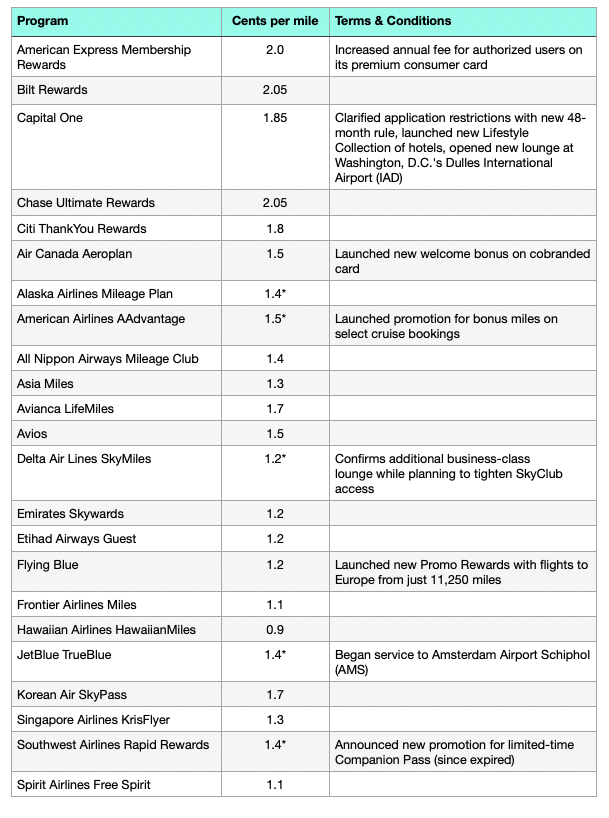
    This is where “The Points Guy” comes in!  They have created formulae to convert points into dollars and cents and vice versa.  If you have an iPhone, feel free to go to the app store and download “The Points Guy” app.  Currently, there is no “Points Guy” app for Androids, so you can use the charts below. 

                Reasons to book fall travel NOW:

    1. Lower Prices: Travel demand plummets as kids go back to school!
    2. Better Deals: Airlines and hotels know fall demand is lower, so they sweeten their offers for cash and points pricing. 
    3. Holidays: There are two schools of thought:  Work around the holidays, or take your vacation overlapping with a holiday to use less Paid Time Off days.
    4. Points, Points, Points: The fall is the best time to cash out on points (before their values go lower) and recently, two major airlines have revamped their FF (frequent flyer) programs.

    NOW is the time to check your points and consider flushing them out, see the charts below, which list cents per mile and bon voyage!!

  • The Tax Advantages of Annuities

    The Tax Advantages of Annuities

    Annuities which are primarily offered by insurance companies are the only financial product on the market specifically designed to convert a lump sum to a guaranteed income. As such, they are powerful tools for hedging against uncertainty and risk. But they also come with robust tax advantages as well.

    The Power of Tax Deferral        

    Tax deferral is a powerful tool that an investor can use to compound potential returns over and above what you might gain using similar investments in a taxable account. Any tax you can put off paying to Uncle Sam is equivalent to taking an interest-free loan from the government and investing it.

    For example, if you make a series of investments that generate $1,000 per year in the first year in interest income and you hold those in a taxable account (such as a bank CD aka Certificate of Deposit), you will likely have to pay $250-$280 to the IRS in income taxes.

    You could only reinvest $720-$750 of that money and let it compound over time. By holding those same investments in a tax-deferred vehicle, however, you get the benefit of compounding the entire amount, year after year after year.

    As investment mogul Warren Buffett has noted, this is the same as the government handing you that extra amount to invest with no payments and no strings attached, if the money stays in the annuity. Yes, you pay income tax on gains eventually, but you get to decide when subject to RMD (required minimum distribution) rules which I will cover below. 

    Annuity Taxation Basics

    If the annuity owner is still living, they are taxed very similarly to traditional IRAs with nondeductible contributions and have many of the same tax advantages.

    • There is generally no up-front tax deduction on premiums (unless you hold the annuity in an IRA).
    • There is no capital gains tax. You can exchange from annuity to annuity as much as you like, using Section 1035 of the U.S. Tax Code, without worrying about capital gains or losses). If you just used mutual funds outside of a retirement account, you would have to pay capital gains taxes on any net gains each year.
    • There are no taxes on dividend income.
    • There is no tax on interest income.
    • Distributions are taxed as ordinary income.
    • You don’t pay taxes on the entire distribution — only the part attributable to growth from non-deductible contributions.
    • Once you turn age 73, (as per the SECURE 2.0 Act of 2022) you must start taking RMDs (required minimum distributions) if the annuity is an IRA (aka qualified or pre-tax money).  This age limit increases to age 75 in the year 2033. 

    Annuity Taxation at Death

    The tax treatment of annuities depends on whether the annuity was still in the growth phase or began paying out income benefits. If the owner dies before the annuity starts paying an income, the beneficiary has several choices:

    • Keep the annuity contract intact and treat it as his or her own (an option for surviving spouses only).
    • Surrender the contract, take the cash immediately, and pay income taxes.
    • Spread out withdrawals as the account MUST be emptied within 10 years of inheritance. 
    • Let the contract continue to grow tax-deferred for 10 years, and then take the entire annuity income at that time.
    • Annuitize the inherited annuity and take payments over 10 years since death.
    • You must decide within 60 days of inheritance. 

    If the annuity has already started paying out income, the beneficiary must continue to take the income at least as fast as the annuitant was taking income.

    As you can see, there are many benefits to having annuities as part of one’s portfolio.  We have access to over 100 annuities and software to identify the highest guaranteed interest rates. 

    For a quote or more information on annuities, feel free to reach out to me at Rob@InsuranceDoctor.us.

  • The TRUE Cost of Faulty Fire Sprinklers

    The TRUE Cost of Faulty Fire Sprinklers

    The Maui wildfires and numerous local lithium-ion battery fires have highlighted the importance of fire safety!

    Fires used to be rare occurrences that you would see on the news; however, because of warmer temperatures and the proliferation of e-bikes, fires now occur every day and the costs are life-changing!

    Here in New York City, fire sprinkler installation was optional for decades until 1999, when it became a mandatory requirement for new and upgraded construction. 

    NYC follows the National Fire Code NFPA-25, which requires monthly inspections of fire sprinkler systems, quarterly functionality testing and Annual Maintenance.

    I own an independent insurance agency.  As a business owner, I must be aware of the various rules, regulations, responsibilities, liabilities, and negligence for NOT keeping up with fire safety upkeep and sprinkler inspections.  If I own or operate a property that others visit and/or accept rent from tenants, there is an obligation and expectation to manage the building with safety in mind. 

    I don’t have to tell you that fire and smoke restoration costs are expensive and estimated at $4.70 per square foot!  Take the square footage of your building and do the math.  Most building owners think they can depend on their commercial insurance company and policy to pay in full in the event of a claim. 

    Here are some insurance policy facts:

    1. ALL commercial and residential insurance policies have fire sprinkler leakage exclusions in the policy wording, meaning THEY WON’T PAY!
    2. Proving fully functional fire sprinklers up front can yield up to a 10% annual discount on commercial and residential insurance policy premiums.
    3. A limited market of insurance carriers will write a sprinkler leakage coverage endorsement should your sprinklers not work during a fire.

    There is a lawsuit currently pending (sprinklers malfunctioned) from a 2022 fire in a commercial building in Queens insured by Nationwide.  There was a fire in the mixed-use building (a store on street level with apartments above) with $2 million in damage.  The insurance company didn’t intend to pay anything.  Upon further review, it was revealed that the insurance agent lied about passing sprinkler inspections on the original insurance application.  Now, both the landlord and insurance carrier are suing the insurance agent for negligence.  We are living in a litigious society!

    You might be thinking, what does this all mean?  First, with over 30 years of insurance experience, I can tell you that insurance companies have gotten better at trying to wiggle out of paying claims. They have gotten pummeled by natural disasters while major carriers are pulling out of states, such as California and Florida, because of excessive claims. 

    It is “Fool’s Gold” to think you can depend on insurance companies to pay in the event of a fire if you haven’t kept up with regular fire sprinkler safety inspections.  It might seem like a waste of money to pay for the inspections; however, it is MORE of a waste to NOT pay and roll the dice in this increasing fire environment with warmer temperatures and dryer climates.

    The bottom line is the choice is yours!  For more information or a second opinion on your commercial or residential insurance policy, feel free to contact me at Rob@InsuranceDoctor.us or call 917-359-3985.  Our website is www.InsuranceDoctor.us. Complete the intake form for quotes.

  • TV Wars: Disney vs. Charter Communications

    TV Wars: Disney vs. Charter Communications

    On Thursday, August 31st, Disney pulled its programming from Charter’s Spectrum TV!   This comes at a convenient time (for Disney) as Disney-owned ESPN networks (FX and WABC channel 7) are covering major live sporting events such as the U.S. Tennis Open and major college football. 

    For sports fanatics, this is one of the best times of the year!  The NFL and college football are back with the NHL and NBA not far behind.  In addition to tennis, ESPN has the contract for Monday Night Football, meaning Charter’s Spectrum TV has 14.7 million subscribers across 41 states who will be “blacked out” from watching the debut of Aaron Rodgers leading the N.Y Jets vs the Buffalo Bills on Monday night, September 11th at 8 pm.  Arguably the most anticipated opening day game in Jets franchise history!

    This “Corporate Greed” reminds me of February 2012 when the previously unknown Jeremy Lin led the Knicks to a 7-game winning streak.  He outscored the great Kobe Bryant while Carmelo Anthony and Amar’e Stoudamire, (the Knick’s two best players) were out hurt.  Lin captivated the country, and it was dubbed “Linsanity!”  The only problem was, that James Dolan and Time Warner Cable had conveniently “Blacked Out” cable subscribers to MSG and the Knicks, due to TV contract squabbles.  I didn’t watch any of those games until 2020 when MSG was looping the “Linsanity” games during the advent of Covid-19. 

    These types of battles with two cable behemoths are common in the industry; however, in the age of streaming, this is different!  Both of their stocks were down over 2% last Friday and Disney stock is near 3-year lows. 

    Last Friday, Charter executives called the Pay-Tv ecosystem “Broken!”  They said they pushed for a revamped deal with Disney that would see Charter cable customers receive access to Disney’s ad-supported streaming services like Disney+ and ESPN+ at no additional cost.  This is where the sticking point must be!

    Of course, this is ALL about one thing, MONEY!  ESPN is said to reap high fees.  ESPN receives $9.42 per subscriber per month, while other Disney networks such as ESPN2, FX, and the Disney Channel charge $1.21 each.

    In the last five years, the entire Pay-Tv ecosystem has lost a staggering 25 million subscribers or almost 25% of total industry customers.  Between the high cost of the traditional bundle and the option to switch to more affordable streaming options, the speed of “cord-cutting” is accelerating!

    The two companies renewed their contract in 2019, which also included Charter integrating Disney+ and ESPN+, as well as Hulu, into its set-top boxes.  Charter is at a disadvantage as they don’t create content; however, they do provide broadband and mobile services.  Charter has seen this coming as earlier this summer they announced an offering of a “sports-lite” package, without regional networks, but with ESPN to customers at a cheaper rate.

    You might be asking yourself, what does this all mean?  I covered the difference between cable vs streaming in December of 2022.  Here are some points and my take on this:

    1. Pressure:  There is tremendous pressure to get this resolved before the 9/11 opening Monday Night Football game between the Aaron Rodgers-led N.Y. Jets and the defending AFC East divisional champion Buffalo Bills!
    2. Morphing: The industry has been morphing towards streaming and getting rid of cable boxes.  For example, if you notice, they are starting to wean baseball games onto Amazon Prime.
    3. Sports vs Non-Sports: Sports and cable are subsidized by non-sports content.  By continually splitting up stations, the business model cannot keep pricing stable.
    4. Look Out for YouTube: YouTube is now the #1 streaming service.
    5. Tipping Point: With two of the biggest players currently battling it out, we are at a “tipping point” or fork in the road as the industry is eagerly awaiting the results.

    I think the Hollywood Reporter said it best, “This can really only go one of two ways: either Charter and Disney come to an agreement, which will force other streaming companies to link up with cable providers, or Charter exits the industry, likely spelling the end of linear TV!”

    For “Financial Wave” readers, “stay tuned” as there are usually money-saving opportunities when technology changes business models, and this could soon be the case!

  • Ease the Energy and Save Money!

    Ease the Energy and Save Money!

    I was watching Good Morning America (GMA) last weekend and they have been showing charts of different U.S. cities breaking heat records for that day and their forecasted high temperatures over the next 4 days. 

    Not everyone buys in; however, from the Hoover Dam to Antarctica, I have seen it for myself, and climate change is real!  Last month, I was on vacation in Redding, Northern California and it was 115 degrees the Friday I flew home.

    The highest temperature I have ever endured was 120 degrees in Sydney, Australia in January 2020, during the time there were wildfires across the continent.  I vividly remember standing in the street in front of our hotel and noticing a different type of burning smell.  It was my flip-flops burning on the blacktop!

    When the electric bills come in, I usually don’t pay them any mind, unless it’s summertime as I know they will be higher than usual.  This summer, between rising electric costs and the hottest July on record since the 1800s, many electric bills are setting the wrong type of record with 25-40% increases as we have been constantly running our AC units.

    As my longtime “Financial Wave“ readers know, a dollar saved is at least $1.20 earned, so here are my 11 money-saving tips on your electric bill going forward and throughout the year:

    1. Close Your Shades & Blinds:  Closing shades and blinds can have an impact on energy costs.  For example, using an umbrella outside to shade oneself can bring the temperature down close to 30 degrees.
    2. AC Unit Tips: Use the economy button.  If you already use economy, try turning it up by 1 degree.  Consider not using AC on lower-humidity nights.  Change your filters every year. 
    3. Adjust Your Refrigerator and Freezer Temperature: Set your fridge to 37 degrees and freezer to 0.  This will keep your food fresh, and your fridge and freezer won’t need to work as hard to maintain the temperature.
    4. Wash Clothes in Warm or Cold Water: Not washing in hot water will save electricity, and your water heater won’t need to work as hard. 
    5. Consider Taking Shorter Showers:  Less water to heat and you will also be saving on water costs.  Hot water is usually the 2nd largest expense in powering most homes. 
    6. Adjust Water Heater Temperature: The default water temperature on some heaters is 140 degrees.  Lowering it to 120 degrees can reduce your energy costs as per Nerd Wallet, by 4-22% annually.
    7. Consider Purchasing Energy Efficient Appliances:  If you are already in the market for a new washer, water heater or dishwasher, buy one with the EPA’s “energy star.”  It uses 12% less energy and 30% less water on average than a regular model. 
    8. Switch to LED Lighting:  Lighting can run an average of 15% of a home’s total energy usage.  Save an average of $225/year (more with larger homes) by swapping out incandescent bulbs. Look for the bulbs that also have the Energy Star label!
    9. Install Dimmer Switches:  Dimmer switches allow you to adjust the brightness of the lighting to both set the mood and save electricity.
    10. Consider Using Smart Power Strips: Some of your electronics such as TVs, computers, and speakers never truly power off as they sit in idle or stand-by mode.  The electricity trickle can have a 5-10% effect.  This might not sound like much; however, when you add up all 11 of these tips, there is real $$$$ to be saved!
    11. Request a Power Audit: Many utility providers will often conduct a home energy audit; some will do it for free.  An audit can help uncover issues such as faulty seals on windows and doors or leaky ductwork which can drain your energy.  An audit can also give recommendations on repairs and other money-saving tips.

    Give it a try and heed these 11 tips.  Should we have above-average humid temperatures this fall, you will be well-positioned to save money every month.  

  • Reducing Expenses with Baking Soda?!

    I went to the grocery store the other day and was taken aback by many of the prices.  A 12-ounce bag of Dunkin Donuts for $13.99, are you kidding me?  A box of gluten-free crackers for $6.99 and a bag of Stacy’s pita chips for $5.99?  The government claims inflation has decreased; however, with our Cross Bay and Marine Park tolls going up and congestion pricing on the way, it seems like we have already “bitten the bullet!”

    There is an old saying, “A penny saved is a penny earned.”  I beg to differ on this point.  If you are in the 20% tax bracket, a penny saved = 1.2 pennies earned, because you need to earn 1.2 cents to net 1 penny saved after taxes. 

    There are many savvy ways to reduce expenses and improve your well-being without sacrificing quality.  Using baking soda (AKA sodium bicarbonate) is one of those ways.  If you go into your “medicine cabinet,” most people will find brand names such as Crest, Efferdent, Axe, Dove, Tums, etc.  Many of these products use baking soda or derivatives like sodium hydrogen carbonate, saleratus, or nahcolite, which are all forms of baking soda.  The difference is these “well-marketed” name-brand products are adding toxic chemicals and preservatives that are making Americans sick and lighter in the wallet or purse!

    Many families have that familiar small orange box of “Arm & Hammer” baking soda in their refrigerator to mitigate bad odors; however, there are so many other uses for this inexpensive miraculous white powder, that help keep your body healthy and clean.  See my Top 10 baking soda usage list below and start the savings and feel better:

    1. Helps Your Kidneys: Kidneys remove waste and excess water from your body.  If you have chronic kidney disease, from diabetes, high blood pressure or other causes, acid can build up in your body.  Sodium bicarbonate can help bring body acid levels down, it can also slow bone loss and build muscle.
    2. Fights Cancer: Emergency rooms and hospitals stockpile sodium bicarbonate (AKA baking soda) as a treatment for poisons, cardiac arrest, and other illnesses.
    3. Body Deodorant: Baking soda removes acid or odor molecules, not just in your fridge.  Try either putting some powder under your armpits (if you are ok with white powder residue) in the morning or buying deodorant with sodium bicarbonate as the main ingredient.
    4. Soothes and Softens Your Skin: Have you been bitten by mosquitoes or rubbed on poison ivy like I have?  Mix 3-parts baking soda with 1-part water and smear on your skin for 20 minutes before washing it off.  Another alternative is to take a bath with 1-2 cups of baking soda which will also soften your skin. 
    5. Kills the Pain: Sodium bicarbonate may boost the pain-killing powers of lidocaine which is used for epidurals.  It can also ease sunburn or windburn by mixing 4 tablespoons per quart of water, using a washcloth, and dabbing the infected area.
    6. Fights Stomach Acid: Sodium bicarbonate fights the acid that runs from your stomach to your throat and even your mouth after eating.  It can be purchased as inexpensive chewable tablets.  If you sometimes get an upset stomach with your morning cup of coffee on an empty stomach, mix baking soda into the ground coffee to cut the acidity.
    7. Facial Scrub: This one is not for everybody as it can be abrasive.  WebMD suggests “first washing your face with a mild, non-abrasive cleaner,” then “make a paste of 3 parts baking soda to 1 part water. Rub it in carefully in circles for a deep clean, then rinse with water.”
    8. Cleans Your Teeth: Baking soda removes plaque which is the sticky film of bacteria in your mouth.  Plaque buildup leads to tarter which can trigger gum disease.  Many people are unaware that your mouth carries the most germs in your body; hence, it is crucial to have good oral hygiene.
    9. Clean Your Child’s Toys:  Baking soda is an alternative to harsh chemicals to use to get the grime off your baby’s high chair, trays, and toys.  It does not kill germs; however, it can be used with vinegar to work as a disinfectant.
    10. Freshens Dentures: As a CSA (Certified Senior Advisor), I know that seniors pay the most money stocking their “medicine cabinets.”  Dissolve 2 teaspoons of baking soda in warm water to loosen food and remove odors from dentures.  This also works for bite plates and mouthguards.

    Source: WebMD

    Costco sells a 13.5-pound reusable orange bag of Arm & Hammer for under $20.  Give it a try!  For more tips go to www.armandhammer.com.

    I welcome your comments and if you want friends/family to be added to our monthly e-newsletter (3 articles/1x/month) email ‘Add Them” with their name and email to Rob@InsuranceDoctor.us

    Let the savings begin!!!

  • Costco: Cracking the Price Code

    Sol and Robert Price raised $2.5 million from friends and family to open Price Club on July 12th, 1976 in San Diego, California.  It was the first warehouse club only for business shoppers in the United States.  The first Costco was opened in Seattle in 1983.  Price Club and Costco merged in 1993 to become Price/Costco and the name was changed to Costco Companies, Inc. in 1999.

    Costco is one of my favorite companies as they are, in my opinion, a model of a customer-centric company that cares about its shoppers.  They also have a unique business model as they need to make a 15% profit minimum on ALL goods and will change vendors if/when net profit falls below that mark.

    Costco is a wholesaler that specializes in selling bulk items with competitive pricing.  The reason why their pricing is so competitive is that they go directly to the producers, buy in bulk, and pass on those savings to their loyal members.  Take wine for example.  Costco will go directly to the vineyards and negotiate their agreement, which is why their wine is so well-priced.

    \What many people do not know is some of their prices have a special code, based on the last 2 digits of the price.  If you learn to decode the Costco price tag, you can save even more money!

    1. If the Price Ends in .97 Cents: It means the item is on clearance.
    2. If the Price Ends in .88 or 00 Cents: The price was lowered by the store manager.  That means it could be an open box or missing pieces.  Look closely before buying!
    3. If the Price Ends in .49 or .79 Cents: It is a manufacturer’s deal and should be grabbed, as it will not be around for long! 

    When I decided to write this article, I had to call my Uncle Walter Meade, who is the family expert on Costco, and he did not disappoint.  Costco is grouped with Sam’s Club and BJ’s in the top tier of member-only wholesale shopping clubs.  Walter went to the first Price Club in New York State, which was in Holbrook, Long Island at the time, and he now lives 5 minutes from a Costco in Tampa, Florida, which he uses as his supermarket.

    ]Uncle Walters’ Lucky 7 Top Costco Tips:

    1. If You Like Wine, Costco is the Spot: Prices are excellent for bottles, cases, and their wine bottle coolers, which hold 25-30 bottles each.
    2. Beware of Sam’s Club: Sam’s Club is owned by Walmart, and in many cases, Walmart sells the same product for less money.
    3. Consider the Costco Visa Card: Costco has its own money-back Visa Card (formerly with American Express) which pays you back once/year.  Walter typically gets between $1,000-$2,000 back annually. 
    4. Costco Travel and Cruise: Costco has a wide range of travel and cruise deals.  They have deals with car rental companies and offer good pricing and consumer protection. 
    5. Go Kirkland All the Way: Kirkland is a subsidiary of Costco and their house brand.  These off-brand items are not only tasty and delicious, but their quality stands up to their higher-priced competitors.
    6. Costco Tires are Worth the Buy: Walter buys all his tires from Costco, and they include (no extra charge) lifetime tire balancing, rotation and tire pressure service built into the tire price.
    7. What to Avoid at Costco: Anybody who has had to take back items to Costco knows they are outstanding with refunds and exchanges.  Not so much for electronics.  Other items that are not as competitively priced are breakfast cereals, condiments and sauces, flour, milk, eggs, and spices. 

    Costco is a forward-thinking company and in 2020 it purchased a logistics company called Innovel.  Innovel helps streamline the “final mile” for bulky items like televisions, appliances, furniture, and fitness equipment to get to your home.  Innovel serves major retailers and the military with more than 1100 trucks on the road daily and more than 4 million deliveries per year!

    For questions, comments, or topics you are interested in learning about feel free to ask me at Rob@InsuranceDoctor.us.

  • Back to School Bargains!

    Back to School Bargains!

    While I know it might seem early, it is August next week.  Time flies and it will be September and back-to-school time before you know it!

    Over the last 2 years, the average cost of back-to-school supplies has increased by a total of 24%!  The National Retail Federation reports that over 50% of consumers already have a head start on back-to-school supply shopping, even at this early date.  They predict that parents expect to spend 10% less this year for a total of almost $600 per child.

    For “Financial Wave” readers that number is too high!  So take a look at these 9 “Back to School” tips before spending the big money;

    1. Make a List Then Check Your House First: Go through all closets, utility drawers, and storage areas first.  You might already have many of the needed items or substitutes left over from last year.
    2. Go to the Dollar Store Next: It is the next best place to buy items before shopping online and/or at the major department stores.
    3. Dollar General: Different neighborhoods have different types and names of dollar stores.  Currently, ‘Dollar General” has $1 deals on scissors, colored pencils, paper and folders, etc.
    4. Google Coupons for Online Purchases:  There are many places to search, like “Groupon” for online coupons and of course, free shipping.
    5. Target: There are good deals to be had with lunchboxes under $10 and some as low as $5 each.
    6. Kohl’s: They are running sales for kids back to school tee shirts as low as $5 each and denim jeans under $30.
    7. JC Penney: They have a sale on Adidas backpacks with “Black Friday’ type pricing at 23% off.  See below for even better backpack deals at Walmart.
    8. Walmart: They have a clothing line called “Wonder Nation” that has very low prices such as 16-inch laptop backpacks for $10 and boy’s slip-on sneakers for $10 and girls’ tee shirts for $5.   Go to www.Walmart.com and you will see the “Wonder Nation” line of deeply discounted clothing. 
    9. Best Buy: They are offering $300 off Microsoft Surface Tablets and Chrome Books for as low as $149.

    Go to www.GoodMorningAmerica.com website for their 50% off discounts.  For the more expensive designer clothing (when kids do the please Mom/Dad all my friends are wearing the “IT” new style) I recommend waiting until after school starts.  This way you/your children can see specifically what is “IN” for the fall of 2023 and perhaps time the Labor Day sale season accordingly.

    For the “Financial Wave,” super savvy shopper who shops off-season and is done with back-to-school, Crate and Barrel is running a Christmas sale offering 50%-67% off for Christmas-based items.   As they say with Lotto, “Hey, you never know!”

  • Marijuana Meltdown

    Marijuana Meltdown

    Late last week I returned from vacation in the mountains of Northern California and Nevada.  On the plane home, I was reflecting on how different life is from the pacific northwest to the tri-state area here in the Northeast!

    My good friend Shannon in Redding, California asked me about a disturbing story he read online on what New York State was doing with our “Recreational Marijuana” Laws and Implementation. He enjoyed my “rant response” which was the trigger to this week’s column!

    California was the first state to legalize “Medical Marijuana” in 1996.  Since then, 40 states and the District of Columbia have legalized medical use and 23 of those states have approved “recreational or adult use.” 

    Washington and Colorado were the first states to legalize “recreational cannabis” use in 2012 as it took California 20 years to pass “adult-use” cannabis in 2016.  On March 31st, 2021, New York State legalized cannabis. 

    According to a new report by MjBizDaily, Americans spent roughly $30 billion on “Legal Marijuana” in 2022, compared to $20 billion on chocolate.  They predict $33 billion this year and by 2028, sales of legal weed will climb to $57 billion.

    New York State was getting into the business for financial reasons as our state lost $25 billion in adjusted gross tax revenue in 2021, because of the exodus of many affluent tax-paying NYS residents who moved to other states!  Although prohibited under federal law, 19 states levy some type of excise state tax on recreational cannabis purchases. 

    New York State Assembly (Source: Flickr)

    One thing I noticed out west is that I barely saw or smelled the pungent aroma of cannabis on the street compared to New York City, where it seems to smell on almost every block.  The reasoning Shannon gave me is because California does not allow cannabis consumption in public places, whereas New York State allows public consumption in places where cigarettes can be smoked which includes near schools and by the entrance steps of train stations, for example.

    A book could be written on ALL the gaffes the current NYS administration has made, which has put us in the “out of control” situation we are currently in.  Here are a few of their mistakes below:

    1. Not Following in California’s Footsteps:  As of 2021 when we legalized Cannabis, California already had 20 years of experience on this issue.  Our recreational rules are too liberal and it’s too late as the damage is done!
    2. Empty Promises to Upstate N.Y. Farmers:  Farmers were told to abandon their crops and grow weed for the 200+ Cannabis dispensaries promised to be opened by 2023.  Currently, New York City has 7 open legal dispensaries.  5 of them are in downtown Manhattan (is this the new Pot District?) within a 10-minute walk from each other, and there is only 1 dispensary in Queens and 1 in the Bronx, with 0 in Brooklyn and Staten Island!
    3. Allowing Illegal Dispensaries to “Spread Like Weeds!”: I have seen NYC Police and news estimates of 1500-1700 illegal shops here in the city.  They are not counting any existing smoke shops or deli’s that are illegally dealing in pot, so the estimate is probably closer to 4000 shops.  Doing nothing for months then raising fines to $10,000 hasn’t put a dent in the illegal businesses, many of whom reopen the same or the next day.

    The combination of not paying attention to recent history, too many licensing red tape delays, and looking the other way, has left us in the precarious position we are in today!  

    Here are some of the results:

    1. Over 300,000 pounds of upstate NY pot was recently disposed of after rotting for almost a year because there are no legal dispensaries to sell it!
    2. With illegal dispensaries and smoke shops outnumbering legal dispensaries in NYC by about 500-1, our tax revenues are going down the drain!
    3. Emergency Room admissions for juveniles due to cannabis-related incidents, like ingesting pot-infused gummies are up over 200% this year.

    These problems are not going away anytime soon and could get worse before they get better.  New York City needs to take immediate action, regardless of what the state does, or doesn’t do.  We have a rat czar, perhaps it’s time for a Cannabis Czar?  Feel free to share your thoughts with me at Rob@InsuranceDoctor.us.