
Blog

  • National Football League $$$$

    National Football League $$$$

    Last weekend I watched what analysts called the best NFL playoff weekend of games all-time!  All 4 games went down to the final play, and both favored number 1 seeds.

    The Green Bay Packers and Tennessee Titans lost at home.  The Buffalo Bills and Kansas City Chiefs put on a show for the ages Sunday night! 

    It makes me think about whether or not the NFL overtime rules should be changed, as Buffalo did not get a chance to respond after the Kansas City Chiefs won the coin toss and scored a touchdown to end the game in overtime.  Under the current playoff overtime rules, the team that has won the coin toss has a record of 10-1.  The only loss was the Saints in 2018!

    The National Football League was formed in 1920 and merged with the American Football League (AFL) in 1966.  Three seasons later, Joe Namath led the heavily underdogged New York Jets to an improbable Super Bowl III win in the 1968-1969 season over the Baltimore Colts.  The Jets have not won another Super Bowl since!

    An old moniker, the (NFL) No Fun League has changed with the times and now allows choreographed team end zone celebrations after touchdowns.  The NFL has come a long way since John Madden (RIP) was coaching the Oakland Raiders in the 1970s.  After leaving coaching, Madden became a great broadcaster using his new “telestrator” toy to teach the viewers at home the way he taught his teams the X’s and O’s of the game.  He continued to keep pace with the times and younger generations with his famous Madden NFL video games.

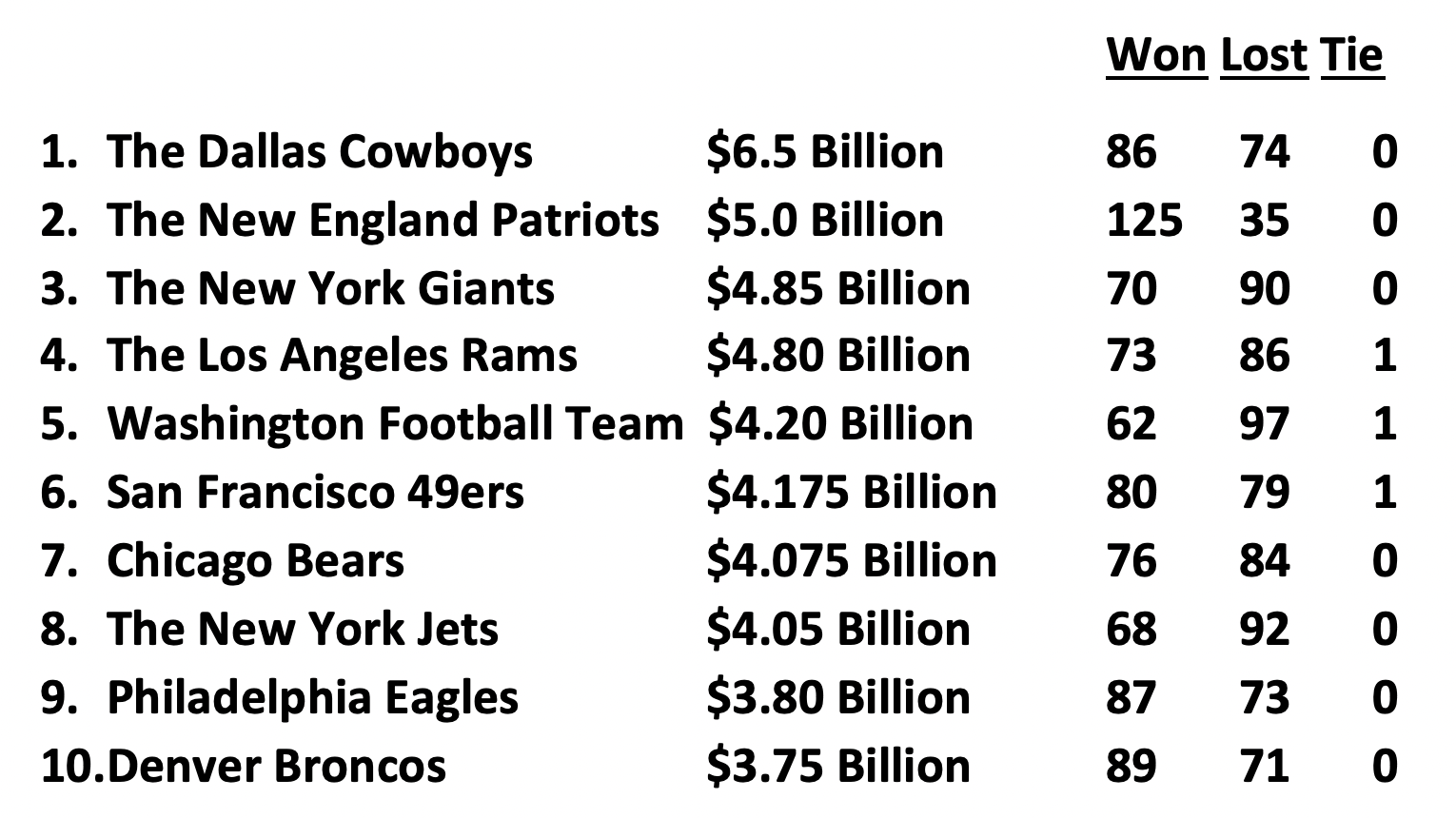
    The 10 Most Valuable Franchises and their 10 Year Records from the decade 2011-2020:                                                                                 
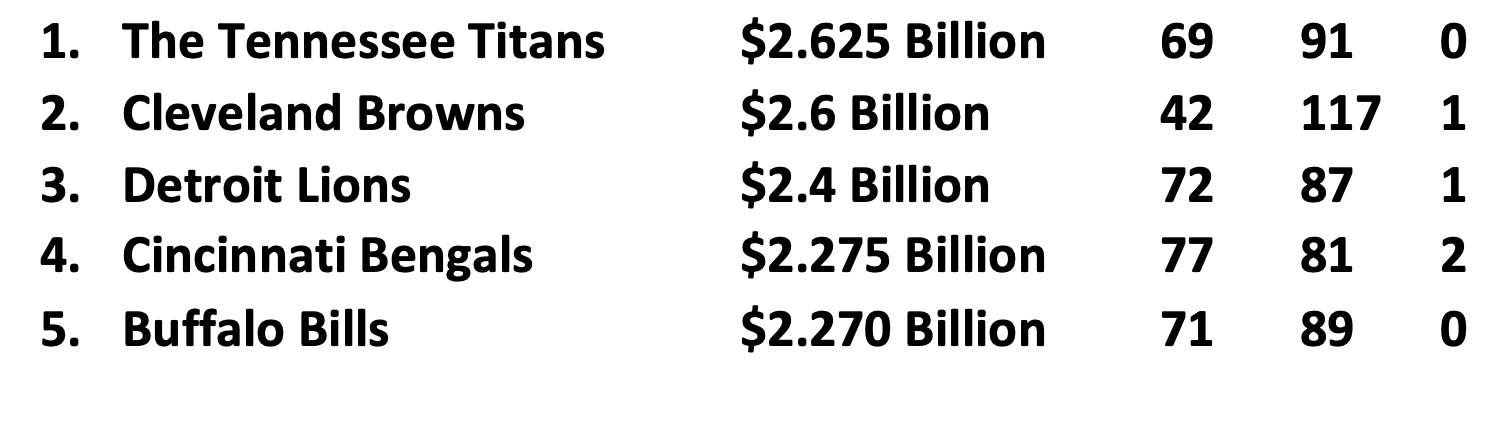
    The Bottom 5 Least Valuable Franchises
    Even with NFL teams taking a financial hit due to Covid-19 restrictions, and playing mostly in empty stadiums in 2020, according to the Forbes financial publication, the average value of NFL teams increased 14% the past year.  A big reason for that is the media partnership deals valued at $112.6 Billion that the NFL signed last March, along with a new Collective Bargaining Agreement.

    For the 15th consecutive season, the Dallas Cowboys topped the Forbes list of the NFL’s most valuable franchises, even though they have not played in a Super Bowl in over 25 years.  According to Forbes, the Cowboys lead the NFL in annual revenues of over $800 Million.  The Cowboys are worth $2 Billion more than the 2 least valuable franchises, the Bengals and Bills, which have a combined value of $4.545 Billion.

    Although every team saw an increase in value in 2020, no team had a bigger increase than the Tampa Bay Buccaneers, after signing Tom Brady and winning Super Bowl LV in 2021.  The Bucs went from the 29th most valuable team at $2.28 Billion to the 21st most valuable at $2.94 Billion. 

    As you can see with our New York Giants and New York Jets, who are 20 and 24 games under .500 respectively for the decade, winning is incongruent to a franchise’s business valuation.

    This fascinated me, so I decided to interview my client and friend Gordon Smeaton.  Gordon spent 20 years as an NFL Executive in charge of fan engagement in global markets.  Gordon is credited with pioneering the NFL pre-season games in Japan, Australia, and Canada.  He set up the first-ever international regular-season game in Mexico City, which then led to the London games now played every season!

    Gordon’s 5 factors that account for the differences in franchise values:

    1. Stadium Size: The number of seats, season ticket holders, personal seat licenses (PSL’s), private suites, club seats and non-shared revenue favor teams that have new facilities and a larger number of premium accommodations.  Larger updated stadiums generate higher per game revenues through ticket sales, parking, food, beverages and merchandise sales.
    2. Stadium Ownership: Not all franchises own their stadia!  Leased facilities tend to drive valuations lower, as revenue may be shared with counties or municipalities, etc.  The most valuable franchises with new facilities tend to attract other events such as concerts, NCAA games, etc.
    3. Market Size: The most valuable franchises are concentrated in larger urban areas, attracting a wider range of partners along with higher prices for sponsorships and advertising deals.
    4. Media: The teams control non-game media so larger markets generate higher revenues for club-controlled content.
    5. Branding: The higher valuation teams are often “National” teams with their fan base spread throughout the country.  This impacts prime-time TV placement and fees that teams can charge their partners.

    It is interesting that the Bills and the Bengals (the 2 lowest valued franchises) were so close to playing this weekend in the conference finals.  Stay tuned for another weekend of exciting NFL playoff games!

  • Vegas In Your Smart Phone!

    Vegas In Your Smart Phone!

    Last Saturday it happened!  Something I never thought would happen, at least with Andrew Cuomo as Governor.  At 9 am on Saturday, January 8th, mobile sports betting went live In New York State,  just in time for the NFL (National Football League) playoffs!

    New York State is the 4th most populous state in the Union, and it is now the largest state to legalize mobile sports betting.  Investors are counting on a “wagering surge” as states such as California and Texas prepare to vote on mobile sports gambling legalization.  As of December 2021, more than two dozen states have already legalized sports wagering.  Several states currently only allow in-person gambling.

    U.S. gambling companies generated approximately $3.25 Billion in total revenue from sports betting in 2021, according to research firm Eilers & Krejcik.  Approximately 20% of that figure came from New Jersey alone.  New Jersey legalized mobile sports betting in 2018.  As I wrote back in September, it is not a coincidence that earlier this year New Jersey announced a “balanced budget” and made “FULL Pension Benefits” for the first time in 25 years!

    A major difference between New York and New Jersey is the taxation rate.  New Jersey has a 13% tax on gambling revenue compared to New York State’s exorbitant 51% tax.  Eilers & Krejcik estimated that New York will not overtake New Jersey as the national leader in gross gaming revenue until 2024.  Gross gaming revenue is defined as the amount of money players wager minus the amount they win.  Annual gambling revenue is estimated to grow to roughly $17 Billion per year by 2026. 

    Are you sick and tired of seeing gambling commercials that seem to be every third ad?  Caesars, in particular with J.B. Smoove (Caesar) and Halle Berry (Cleopatra) seem to be on TV and radio twice per hour.  Get used to it as sports gambling companies jockey for positions to obtain new gambling customers located in New York State.  Gambling advertising budgets are so big, it is estimated that it will take 2-3 years for gambling companies to make a profit.  The reason for this is the taxation rate and their substantial advertising budgets.

    Currently, there are 4 approved mobile sports gambling platforms:

    1. DraftKings- Rated the best app in the game to navigate and place bets
    2. FanDuel- Biggest market share currently in the U.S.
    3. Caesars- Most generous initial bonuses $300 to sign up, 1st deposit match up to $3,000
    4. BetRivers (The ownership group of Rivers Casino and Resort upstate in Schenectady, N.Y.)- Not as well known as the other 3; however, with similar reach and active in over 10 states

    These 4 approved gambling companies have a major leg up on the 5 companies pending conditional approval, and they are spending millions upfront to acquire new players located in New York State.  These 5 pending companies are holding 10-year online sports betting licenses in New York, but have not yet passed the extensive statutory and regulatory requirements to go live.

    The 5 pending gambling companies pending are:

    1. Bally Bet
    2. BetMGM
    3. WynnBet
    4. PointsBet and
    5. Empire Resorts

    In order to understand more about this critical time for online sports gambling, I interviewed our Assemblywoman Stacey Pheffer Amato.  She co-sponsored the bill initiated by our State Senator Joseph P. Addabbo Jr.  I asked her about what prompted her to co-sign the bill.  Some of her points included:

    1. It will create many local and union jobs
    2. It will increase needed New York State revenues
    3. There are many safeguards and consumer protections not found elsewhere such as European websites and offshore gambling
    4. New Jersey “Is the proof” that it works on a state level
    5. Money is earmarked for youth school sports teams, equipment etc.
    6. Money is also earmarked for education grant programs
    7. NY will benefit from airport travelers gambling during overnight stays
    8. There are precautions for addictions
    9. It presents an opportunity for sports fans
    10. In moderation it is responsible adult recreation

    It remains to be seen how this New York State legalized mobile sports betting rollout is received.  What do YOU think about the new mobile sports betting program?  Feel free to email me at Rob@InsuranceDoctor.us.

  • A Slice of Queens!

    A Slice of Queens!

    PIZZA is my favorite food! My passion for pizza goes way back to my early childhood when my Sicilian Grandmother, Anna Leonardi-Intelisano, made her own pizza for us.  At our house, we would often have pizza on Friday nights with cannoli for dessert.

    Pizza was invented in Naples, Italy in the early to mid-1800s.  The classic Margherita-style pizza was named after the Italian “Queen Margherita!”  In celebration of the Queen’s visit to Naples in 1889, a popular pizzeria made a pizza pie to match the green, white, and red of the Italian flag.

    Pizza became popular in the United States in late 1945, when returning soldiers who were stationed in Italy fighting in WWII spread the word. The first pizzeria in the U.S.A. was Lombardi’s, which opened in 1905 in Manhattan.

    I led a pizza crawl in Greenwich Village in October 2019, which started at Famous Ben’s, then on to Prince Street pizza, (my #1 pepperoni Sicilian slice) followed by a fabulous sit-down meal in the Lombardi’s famous basement dining room.

    I have asked many people the question, “Who opened up the first pizzeria serving slices in Queens?”   Unless you live in the Woodside area, the odds are good you will not know the answer. 

    The story goes back to 1954.  My Grandma Anna loaned $3,000 to her “Compare” Alfredo Leotta, to make his dream come true!  Anna was the Maid of Honor at Alfredo’s wedding.  He opened Alfredo’s Pizzeria later that year.  Alfredo’s was the first pizzeria in Queens to serve SLICES of pizza.  Alfredo’s was located diagonally across from the original Saint Sebastian’s Church, which was demolished when the Parish bought the Loew’s Theatre on Roosevelt Avenue and 58th street in Woodside. 

    The original cost for a slice was 25 cents.  Alfredo was a tremendous pizzaiola; however, he did not speak English well and did not know how to properly run a small business.  Alfredo should have considered joining the Queens Chamber of Commerce, created in 1911!  After 5 years of limited profitability, Alfredo decided to close the business and went into landscaping.

    Shortly after Alfredo’s Grand Opening, word traveled and there were other pizzerias in the works.  Below is the list in chronological order of The First 10 Queens Pizzeria Openings:

    1954 Alfredo’s Pizzeria in Woodside

    1956 New Park Pizza in Howard Beach

    1959 Dani’s House of Pizza in Kew Gardens

    1959 Rizzo’s Fine Pizza in Astoria

    1959 VIP Pizza in Bayside

    1960 Pizza Garden in Flushing

    1960 Gloria Pizza in Flushing

    1961 Freddy’s Pizzeria in Whitestone

    1962 Lucia Pizza in Flushing

    1963 Brother’s Pizza in Fresh Meadows

    Recently, a food and restaurant dining review website called “The Infatuation,” published their top 24 New York City pizzeria list.  It included the 5 boroughs and northern New Jersey.  Guess how many Queens-based pizzerias were on their list?  Answer: ZERO!

    This disrespect extends to Rockaway’s burgeoning “foodie” scene.  Rockaway has recently added Rocco’s of Roc Beach and Pizza D’Amore to established spots such as Whit’s End, Ciro’s, Plum Tomatoes, Boardwalk and Elegante to name a few.

    Since the early 1960s, the price of a regular New York Slice has almost matched the price of a subway token.  This was called the “Pizza Principle” or the “Pizza-Subway Connection!”  This held true until roughly 6-8 years ago when pizza prices started to ramp up and became a huge money-making business.  Now, mostly due to inflation and Covid-19 based supply-chain ingredients shortages, many pizzerias charge anywhere from $4-$5 per gourmet slice, with toppings. 

    Americans LOVE pizza regardless of how much the slice costs! 

    Courtesy of FactRetriever.com, my top 10 pizza factoids are:

    1. In America, annual pizza sales exceed $28 billion per year.
    2. Over 5 billion pizzas are sold every year in the world.
    3. Over 3 billion pizzas are sold every year in the United States.
    4. Americans eat approximately 350 slices per second.
    5. Recently, Halloween unseated Super Bowl Sunday as the biggest pizza consumption day.
    6. Thanksgiving is the day Americans eat the least amount of pizza.
    7. October is national pizza month.
    8. The average American eats about 46 slices or 23 pounds per year.
    9. The most popular pizza topping in the USA is pepperoni.
    10. Lady Gaga once bought $1,000 worth of pizza for fans waiting in line for her autograph!

    Where is YOUR favorite Rockaway slice from?  Does YOUR favorite pizzeria NOT get the proper respect?  Email me your favorite pizzeria and slice at Rob@InsuranceDoctor.us.

  • 6 Steps for Finding a Lost Life Insurance Policy

    6 Steps for Finding a Lost Life Insurance Policy

    According to the CDC (Centers for Disease Control and Prevention), The Covid-19 pandemic drove average life expectancies in the United States down by 18 months last year (the calendar year 2020), making it the largest decline since World War II. 

    Americans are now expected to live an average of 77.3 years, down from 78.8 years in 2019.  Covid-19 deaths accounted for nearly 75% of the decline.  About 11% of the decline stems from the rise in deaths from accidents and/or unintentional injuries.  Drug overdose deaths (+30%) make up about one-third of unintentional injuries last year. 

    Life expectancy for American women dropped by 1.2 years in 2020 and men dropped by 1.8 years.  The gap between men’s life expectancy and women’s life expectancy has widened to 5.7 years in 2020 from 5.1 years in 2019. 

    What does this all mean?  It means that planning should be adjusted for a shorter life.  As interest rates rise, annuities will play a larger role in planning as will Life Insurance.  Compared to pre-pandemic times, people have shifted their relationship to mortality and death and are able to discuss it more comfortably.

    When someone dies, it’s not uncommon for their life insurance benefits to remain unclaimed because their beneficiaries didn’t know about the policy.   Life insurance companies try to contact beneficiaries however people often move, don’t check their emails, and sometimes change their names.  Fortunately, there are solutions for tracking down policies by using these 6 tips!

    1. Search for Insurance Documents: Look through paper files, financial folders, safe deposits boxes or home safes.  Check for bills, the insurance broker’s business card, the cell phone or address book of the deceased for information.
    2. Check Financial Records: Check bank statements, financial ledgers, and copies of checks to see if payments were made to any insurance companies.
    3. Contact the Decedent’s Employer: If the decedent was employed or recently left a job check with their employer.  Many companies offer small group term policies that could cover funeral expenses.  Also, these group plans may have been continued or converted into a permanent policy when the job ended.
    4. Contact the Unclaimed Property Office: Every state has a department for unclaimed property.  If a life insurance company is aware of the death of a policyholder and cannot locate the beneficiary, the policy is reported to the unclaimed property office in most cases.  The funds are submitted to the unclaimed property office in the state where the policy was purchased.  If the decedent moved several times, it may be necessary to contact the offices of each state they resided in the past.
    5. Check the MIB Database: The MIB group (Medical Information Bureau) is a not-for-profit company made up of life and health insurance affiliates.  They keep a database of all policies written in 1996 or after by companies that are members of the group.  Since the fee is about $75 save this as the last resort.
    6. Tell Family, Beneficiaries and/or Friends:  Many people never tell their beneficiaries about their policy because of the grim nature of the subject.  We suggest completing a simple “estate directory” which lists policies, beneficiaries and where the files are being kept. 

    To learn more, feel free to contact us at Rob@InsuranceDoctor.us.

  • 8 Financial Tips for Your New Year’s Resolution

    8 Financial Tips for Your New Year’s Resolution

    Six out of ten American’s will make some type of financial-based New Year’s resolution for 2022.  Usually, there is a triggering event like receiving your December 2021 credit card bill or spousal pressure to name two.  Follow these tips for improved financials in 2022:

    1. Consolidate Financial accounts: Consider closing 1 or 2 existing financial accounts that you are not tracking or have insignificant monies in.  This will save brain space, reduce statement clutter, and avoid paying unnecessary fees.
    2. Increase your 401k/employer retirement contributions:

    Raise your contributions a minimum of 1% per year.  You won’t feel the difference; however, over time it can make a major impact when entering retirement.

    • Develop a budget and or expense statement: Review credit cards, bank, and checkbook statements to get a handle on your inflow and outflow of money.  Start using a program like Quick Books or if old school, draft a budget by hand and hang it up where you can see it.
    • Set up a systematic money saving program:  Set up something informal like putting the $20 you are saving in gas on fill-ups in a jar.  Formal ideas are even better, such as buying a cash value life insurance policy, tax deferred annuity, mutual fund or setting up an Eft thru your bank account.
    • Protecting your HEALTH saves your WEALTH: We all know about the escalating cost of health insurance and health care in general.  Renew that gym membership, yoga studio membership, buy a Peloton, or dust off that treadmill in the garage.
    • Use All of Your Flexible Spending Account Money: If you have set aside pre-tax wages to go into a flexible spending account, (FSA) you have until December 31st to spend down the qualified expenses.  These expenses can include deductibles and expenditures that your health, vision or dental plans do not cover.  Double check if your employer allows you to “rollover” unused FSA money to 2022.
    • See If the Doctor Is In: If you have already reached your 2021 deductible on your health insurance policy, consider sneaking in that last doctor’s visit or procedure you have had on your to do list for 2022 before year end.
    • Bring balance to your life: Consider taking that vacation in January or February that you have been putting off.  The rest and rejuvenation will positively impact your health.  Statistics show that those who work 46-48 weeks per year will out produce the 52 week per year worker.

    My vacation experience gives me something to look forward to.  It is easier for me to work longer hours during year-end knowing I will be going away shortly.  Vacations force me to be super productive before leaving and again when catching up after returning home. 

    You will be amazed about how much better you will feel by following these 8 easy steps!  Wishing you and your family a Happy, Healthy and Prosperous 2022!

  • 2021 Year End Travel to Do List

    2021 Year End Travel to Do List

    Year-end is a time when many people, myself included, review what happened, how did I do versus my goals, investment returns, etc.  Just like you might want to review your bank accounts, now is a good time to review your hotel and airline travel points and miles balances. 

    My Top 5 Travel to do Tips Before January 1st, 2022:

    1. Check Your Progress to Airline Elite or Gold Status
    2. Check Your Progress to Hotel Elite or Platinum Status
    3. Review Your Credit Cards to See if You Still Need Them
    4. Redeem Free Travel Credits if You Qualify
    5. Research How to Get Back Miles That Expired This Year

    Most airlines will require you to earn or redeem airline miles within a certain timeframe to keep them from expiring.  Due to Covid-19, many people are not traveling right now nor keeping track of their miles and airline mileage programs.  Some airlines have suspended mileage expiration through the end of 2021 or thereafter.

    Several airlines have eliminated expiring miles completely, offering tremendous travel flexibility going forward.  Those airlines are Delta, JetBlue, Southwest, and United Airlines!  Keep in mind, these rules are subject to change, so be sure to read all emails and, if possible, upload their airline Apps onto your smartphone.

    For Hotels, aside from the Hilton Honors Program, most of the large hotel chains do NOT have a standard points reinstatement policy.  Instead, most of the large hotel chains have in place a suspended points expiration policy.  Hilton Honors, Choice Privileges, and Radisson Rewards are a few chains that have suspended point expiration until December 31st, 2021.

    Buying back expired miles and hotel reward points can be expensive and is not always worth it.  A better strategy is to prevent your miles from expiring in the first place. 

    For example. Hilton is the only hotel rewards program that allows you to reinstate expired points at the rate of 25 cents per point.  If you are looking to reinstate 120,000 hotel points for a night at the Waldorf Astoria in the Maldives, it would cost $300 to reinstate.  That fee could be worth it as the rooms at this resort regularly costs $2,000 per night.

    As per www.ThePointsGuy.com, the best strategies to prevent your airline or hotel points from expiring are:

    1. Go to the Airline or Hotel Website and Review Their Point System: Each company has different definitions of “activity!”
    2. The Easiest Ways to Keep Miles from Expiring is to Keep Earning or Redeeming Them: For those not traveling, consider the next strategies.
    3. Earning Miles Through Credit Cards: Some airlines and hotels count their own credit card expenditures or transferring balances as activity.
    4. Food and Shopping Programs: Some airlines allow you to earn points through certain shopping and dining portals.  For example, American Airlines has their “Rewards Program Portal” where you can earn points at certain restaurants and store websites, such as Staples.com.
    5. Non-Affiliated Credit Cards: Credit cards such as Chase “Ultimate Rewards,” Amex “Membership Rewards,” Citi “Thank You Points,” Marriott “Bonvoy Points,” and Capital One “Venture Miles,” allow you to transfer rewards to many of the frequent flyer programs.
    6. Donate Points to Charity: If you have a stash of limited points with an airline you rarely use, most of the major airlines will allow you to donate them to a charity.

    Regardless of which strategy you may use, it is worthwhile to spend some time on this to research ways to keep your hotel and airline points from expiring.  Wishing you Happy Travels and Happy Holidays to you and your Family!

  • Holiday Scams to Avoid

    Holiday Scams to Avoid

    Stay a step ahead of cybercriminals this season by being aware of these scams.

    It’s no wonder so many of us look forward to the holidays. It’s a time to gather with family and friends, share memories and gifts, and make plans for the coming year.

    Manage your Wealth

    Top of Form

    Bottom of Form

    Cybercriminals look forward to the holidays, too—but for starkly different reasons.

    This time of year represents an opportunity to unleash their schemes on a busy, distracted audience that’s focused on merriment, not mayhem. But being aware of some common scams can help keep you safe throughout the holidays.

    1. Package Delivery Scams

    An estimated three billion packages were shipped during the last holiday season.1 So, it’s not surprising that cybercriminals have concocted several schemes related to package deliveries.

    A popular scam involves receiving a text or email that asks you to click on a link for a number of phony reasons, such as to get an update about the delivery date, track the package location, give your payment preferences, provide delivery instructions or pay a shipping fee. You may also be given a phone number to call for more information about your delivery. Since fraudsters want you to act without thinking, they may convey a sense of urgency in their message.

    While some of these communications are obviously fraudulent—perhaps containing multiple misspellings or other errors—many are carefully crafted, even replicating a shipping company’s logo or email format in some cases.

    So, it’s easy to get duped, especially during the hectic holidays.

    Unfortunately, clicking on the link may infect your phone or computer with malware that enables a cybercriminal to capture your passwords or take control of your device. Or it may direct you to a form that requests personally identifying information, which can be a gateway to identity theft.

    Calling the number typically leads you to a friendly-sounding individual who asks you to verify your personal information or provide the credit card number used for your purchase. You might also be requested to pay an additional delivery fee, customs fee, or tax for the package.

    If you receive any of these communications, it’s best to simply go to the shipper’s website for more information about your alleged delivery using the tracking number provided. (Type the website address directly into your browser because search results may lead you to a fake or phishing site that mimics the authentic one.) Or call the shipper using a verified phone number.

    Sometimes scammers take a more aggressive approach and call you pretending to be a representative from a package delivery service. If this happens, don’t provide any personal information—just hang up. If you receive a voicemail with a call-back number, don’t return the call. 

    2. Missed Package Scams

    Who doesn’t hate missing a package delivery?

    Cybercriminals know this. So, they’ve created a ruse that involves leaving a note on your door claiming to have a package for you that couldn’t be delivered. The note contains a phone number to call to reschedule the delivery. If you call the number, you’ll be greeted with questions related to your personal identity that can later be used to commit fraud.

    If you receive a missed delivery note, look at it closely for any mistakes or other signs that it could be fraudulent. (It’s also a good idea to check your recent orders to see if a delivery was scheduled for that date.) Even if the notice looks legitimate, don’t call the number listed on the note. Instead, visit the company’s website to find the official customer service number.

    3. Gift Card Scams

    ‘Tis the season for gift cards. So, naturally, scammers have devised some ploys to take advantage of this.

    A common gift card scam involves receiving a phony or “phishing” email or text that appears to be from someone you know—such as an executive at your company—and asks you to purchase multiple gift cards for a work-related function. Or perhaps it’s a personal request allegedly from a relative or friend who claims to need some help with ordering gift cards.

    If you receive any unusual requests for gift cards during the holidays, reach out directly to the individual by phone to confirm the authenticity of the request. 

    4. Social Media Scams

    During the holidays, you might see promotions or contests on social media sites offering gift cards or vouchers in exchange for simply completing an online survey. Unfortunately, the survey usually isn’t legitimate. It’s only a means of capturing your personal information to commit identity fraud or other types of cybercrime.

    Or you might be offered a prize for just liking or sharing a social media post. But doing either could infect your device with malware.

    The bottom line? Be extra cautious during the holidays on social media, especially with enticing offers that seem unusually generous.

    5. “Brushing” Scams

    While the name of this scam is odd, the scam itself is even odder.

    You’ll receive a package you didn’t order bought from an online marketplace that allows customers to post reviews of their purchase. The item is typically cheap and lightweight.

    Since it’s the holiday season, you might think it’s just a gift from a stranger looking to pay it forward. In reality, it’s likely from someone who sells products on online marketplaces who wants to create fake, positive reviews. But, in order to post a review, the marketplace requires that a transaction be verified with a legitimate tracking number that shows a successful delivery.

    And that’s where your mystery package comes into play. That purchase creates a tracking number. So, after the package is delivered, your fake gift giver can write the review.

    The good news? You won’t be charged for the item, and don’t have to return it. Often the sender just randomly found your name and address online.

    However, it’s possible the fraudster created an online account for you at the marketplace or hijacked your existing account. So, you should report the activity to the marketplace. If you have an account at the site, change your password immediately. The United States Postal Inspection Service offers additional information about this scam.

    Taking Action

    We hope you’ll enjoy the holidays without the stress of dealing with fraud.  But, if you’re a victim, here’s what to do:

    • Report the crime to local law enforcement
    • Alert your banks and credit institutions
    • File a complaint with the FBI
    • Report the scam to the FTC

    Even if you simply encounter a scam, the FTC encourages you to report it to help others avoid becoming a victim

  • Post-Thanksgiving Holiday Shopping Tips

    As we enter the post-Thanksgiving holiday season, I was thinking about what I am thankful for.  In addition to good health, my family, and friends, I am thankful to “The Wave” for giving me the opportunity to create “The Financial Wave” column back on May 1st, 2020! 

    I saw a piece on the news this week that people are feeling pressure to spend money on holiday gifts.  Chanukah starts this weekend and Christmas is right around the corner.  Heed these 7 tips to save $$$ and reduce holiday shopping stress this season:

    1. Start Your Holiday Shopping Now: There is a saying “Action Diffuses Anxiety!”  Getting into action and knocking off items on your list now will reduce your stress levels.  Also, due to product shortages and issues with standard mail, it is wise to commence now.
    2. JoinHoney.com: On your IPAD, desktop or laptop, click on www.JoinHoney.com (does not work on mobile phones) and add the extension to chrome.  Honey automatically (similar to Capital One and others) searches for the best prices and attaches coupons when you are at the checkout section while internet shopping.  This often can save you more money than using Amazon and Ebay.
    3. Make a Budget:  Budget “X” dollars per person and keep the list with you when you are shopping either online or in brick-and-mortar stores.  Sticking to your budget is just as important as crafting it!
    4. Points, Points, Points: Using points is a very good way to bring prices down.  Credit card points, Verizon, AARP and many other companies and retailers have point programs that can mitigate high pricing.
    5. Buy Hot Toys Early: Research shows that, unlike other items, prices (and availability) of toys are better the earlier you can buy them.
    6. Search Out Free Shipping: There is no reason to pay extra for shipping if you do not have to.  These savings can add up over multiple holiday gift purchases. 
    7. Consider Switching to a Secret Santa:  Years ago, during a family dinner, the topic of doing your own Christmas shopping came up.  When my mother estimated she was buying about 80% of all the family gifts, we decided to adopt the “Secret Santa” program for us adults.  The way this works is that each adult (we still spoil the kids) is assigned one other adult to buy for, with a maximum price cap. 

    Last but not least, I would like to thank YOU, the loyal Wave subscribers and “Financial Wave” readers for your support! 

    For those interested in being added to our monthly email list or if there are topics you are interested in learning about, by all means email me at Rob@InsuranceDoctor.us.  Happy Holidays!!!

  • Inflation & Pizza

    Inflation & Pizza

    You will be hearing about inflation frequently during this holiday season.  The current administration forecasted a 2% inflation rate.  The Consumer Price Index numbers were just released, and from October 2020 to October 2021 the inflation rate was 6.2%!  This is the highest increase in the last 30 years!

    My friend Jay (originally from New Jersey) was in town from Maryland this weekend, and his favorite pizza is from New Park, so we had to go last Sunday before heading to Madison Square Garden for the Rangers vs. Devils game.  We were 3rd in line after 2 gentlemen who looked like they were in their late 60’s.  When the first man’s pie order came out, he asked, “how much do I owe you?”  The worker said $27 to the surprise of the man.  I said, “inflation just kicked in right now” and all 3 of us laughed. 

    Since the early 1960s, the price of a regular New York slice has almost matched the price of a subway token.  This was called the “Pizza Principle” or the “Pizza-Subway Connection!” 

    From New Park, I needed gas and paid over $4 per gallon for 91-octane on a credit card.  I have seen gas in Manhattan for $5 per gallon.  As per the Automobile Association of America, the national price of regular gas is currently $3.41 per gallon.  The New York State average is $3.56 per gallon.  The Manhattan average price is $4.33 per gallon. 

    This got me thinking about what has caused this inflation to be running rampant!  Basic economic supply and demand are what triggers inflation.  There are root causes for what is going on right now and we must adjust our budgets to cover these higher costs.

    The reasons include, but are not limited to:

    1. Government Covid Relief Bill: This bill disincentivized some people from returning to work. Now employers are seeking workers and paying higher salaries to hire them.  Increased wages cause inflation.
    2. Supply Chain Shortages and Delays:  The majority of US goods are trucked from coast to coast.  There is a shortage across of 80,000 truckers across America.  Long-haul truckers have gotten a raw deal over the years as working conditions have deteriorated.  According to the U.S. Bureau of Labor, the median trucker salary is only $47,000 per year, and adjusted for inflation, their purchasing power is down 30% from 1970-2020.
    3. Increased Costs of Raw Materials:  A combination of factors including increased gas and transportation costs and food shortages have driven up prices.  Your favorite Queens Pizzerias are paying more for tomatoes, cheese, basil, olive oil and cardboard boxes.  Some of these prices increases have been passed on to the consumer.
    4. Corporate America: When the pandemic first hit in 2020, corporations such as the airlines and automakers, went into survival mode and cancelled semiconductor orders, furloughed workers and slowed down production, which created supply shortages.  As the public had more disposable income, the demand increased faster than the bounce back in supply.  Unfortunately, this is not going away anytime soon.

    In summary, this will really impact Americans this Thanksgiving and Holiday Season.  This is a good time to adjust budgets and control spending, as your dollar will not go as far as it used to. 

  • Biden’s Gift to New York!

    Biden’s Gift to New York!

    Last weekend, President Biden’s $1.2T infrastructure bill passed, in a bipartisan Senate and House of Representatives. This bill will have a disproportionately positive benefit for New York and Rockaway in particular!

    There is an old saying, “the squeaky wheel gets the oil,” and this is what is going to happen with New York since we have more infrastructure needs than every other state except California.  If initial estimates hold true, roughly $170B (over 14% of the total) would be earmarked for New York State infrastructure projects.

    The New York Funds Breakdown is as follows:

    1. $12.5B:  For Roads, Highways, Bridge Repair, Electric Vehicle Infrastructure.
    2. $1B: For our 3 Airports:  JFK, $300M, Laguardia, $150M and Long Island MacArthur, $21M.
    3. $58B: For Trains:  $22B for Amtrak Improvements (includes the Gateway Tunnel to NJ Project, $24B for Northeast Corridor Modernization and $12B for Intercity Passenger Rail, including a “High-Speed” Rail! In addition, completion of the 2nd Ave Q-train to 125th st. and installed handicapped-accessible elevators at all stations.
    4. $90B: For Water Infrastructure:  $14.7B for the EPA (Environmental Protection Agency) Drinking Water Revolving Fund (provides grants and loans for projects). $14.7B for the EPA’s Clean Water Revolving Fund (for water quality improvement) and $55.4B in Supplemental Emergency Appropriations. 
    5. $9.8B: For Clean Buses and Mass Transit.  

    While this bill is a “game-changer,” I have mixed feelings about it.  To use an insurance term, it is great to see that both parties can come to somewhat of a consensus by “unbundling” the bill and breaking it off the proposed $2+T “Social Spending” bill.  

    My top 5 benefits to the United States from this bill:

    1. It will create hundreds of thousands of jobs and get people off couches!
    2. This will be a boon to the “Steel Industry!”
    3. Additional Modern Roads Will Increase Trucking Efficiencies and Cut Back on Carbon Emissions!
    4. Increase Domestic job creation!
    5. Drinking Water Quality Will Improve, Which Will Improve American’s Health.  There is a Water Company Called “Heart Water” That Could Solve Our Water Problem if Given the Chance to Scale (keep a lookout for a future column on this).

    As we all know, Rockaway has been devastated by Super Storm Sandy. We have shown our resiliency building Rockaway back better over the past 9 years.  This splurge of money can be used to:

    1. Fix Rockaway’s roads, especially Beach Channel Drive.
    2. Develop Additional Transportation Methods from Rockaway to Manhattan.
    3. Continue Improvements for future storm resiliency.
    4. Create new jobs in Rockaway.
    5. Prices of electric vehicles will come down as auto makers introduce their new EV models.  I predict the 2023-2024 models will be the optimal time to buy electric!  Buying electric and adding charging stations will improve Rockaway’s air quality and reduce carbon emissions.

    The general public might not find It easy to grasp how much $1 Trillion dollars is, as we could have done this while spending less money.  According to www.USDebtClock.org, the current US Deficit sits at $28.8 Trillion or $86,637 per person.  The proposed $3.5T package (not yet passed) would be equivalent to over 12% of our current deficit.

    To give an example how we got ourselves into this deficit situation, look at the Federal deficit progression below:

    President: Debt at Start of Office                       Debt When Leaving Office

    George Washington (1789-1797)                       $82 Million:  211 years later

    William J. Clinton (1993-2001) $4.4T                 $5.8 Trillion

    George W. Bush (2001-2009) $5.8T                  $11.9T

    Barack Obama (2009-2017) $11.9T                   $20.2T

    Donald J. Trump (2017-2021 $20.2T                 $27T

    In summary, this is the largest investment in domestic infrastructure since the 1950s!  It is prudent to spend money on long-term projects with trickle-down effects that will improve this country and our quality of life.